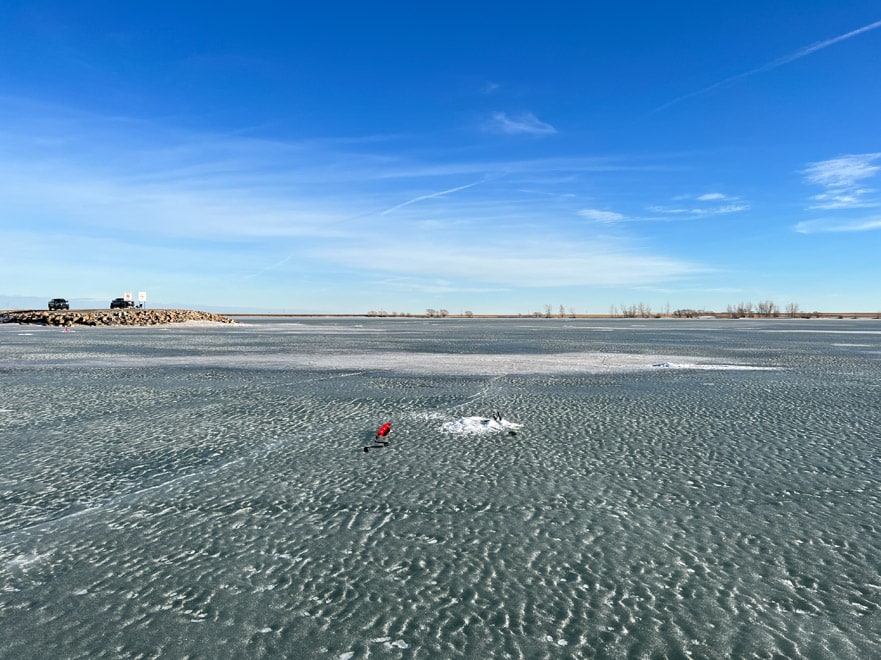
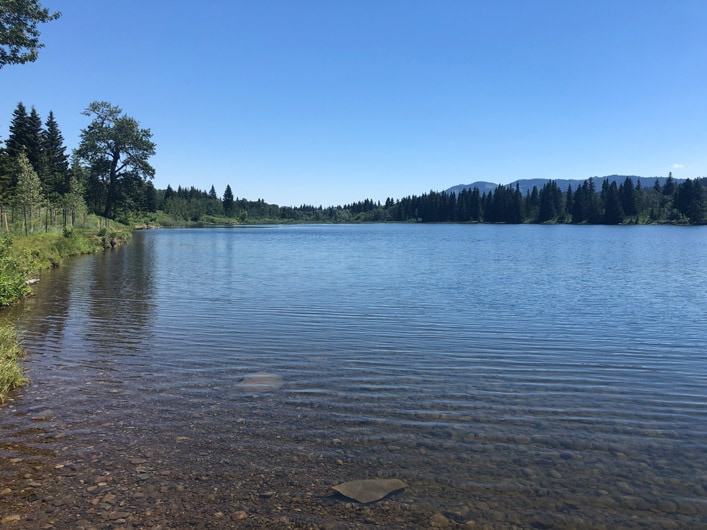
McQuillan Reservoir is a small stocked rainbow trout fishing destination southeast of Coaldale, approximately 34 kilometres from Lethbridge.
It is one of the lesser known trout fisheries in southern Alberta, but there is a good reason to give it some attention.
Unlike many small stocked ponds where trout struggle to survive through winter, McQuillan has documented evidence of fish surviving multiple seasons and growing substantially larger than their original stocking size.
Alberta Conservation Association researchers have captured rainbow trout measuring up to 59 centimetres in the reservoir.
That does not mean every trip will produce a large trout. However, it does make McQuillan an interesting alternative to the more familiar stocked ponds around Lethbridge.
Where Is McQuillan Reservoir?
McQuillan Reservoir is located southeast of Coaldale in Lethbridge County.
The Alberta Conservation Association identifies the reservoir at SW 13, Township 8, Range 19, West of the Fourth Meridian.
According to its current access directions, visitors travelling from Coaldale should head south on Highway 845, turn east onto Township Road 82, continue north on Range Road 191 and follow the access road east into the site.
The reservoir is also located across the road from Indian Hill Golf Club.
The surrounding landscape consists primarily of agricultural land, making McQuillan feel quite different from a forested trout lake in the foothills.
It is a quiet rural fishing destination rather than a developed provincial park.
What Fish Are in McQuillan Reservoir?
Rainbow trout are the main sport fish.
McQuillan is part of Alberta Conservation Association’s established trout stocking program, and recent provincial stocking records consistently list rainbow trout.
However, an ACA fisheries survey also identified several other fish species living in the reservoir.
Researchers documented:
- Fathead minnows
- Brook sticklebacks
- White suckers
- Longnose suckers
These smaller fish are interesting because they help explain how McQuillan supports larger trout.
Young minnows and other small fish can provide food for predatory trout, while aquatic insects form another important part of the reservoir’s food supply.
Northern pike, walleye and yellow perch are not confirmed as established sport fish populations at McQuillan.
If you are planning a fishing trip, rainbow trout should be your primary target.
Can You Catch Big Rainbow Trout at McQuillan Reservoir?
Yes, and there is actual fisheries research supporting that possibility.
In 2021, Alberta Conservation Association surveyed McQuillan Reservoir as part of a project evaluating trout survival in smaller stocked waterbodies.
Researchers captured 144 rainbow trout.
The fish ranged from approximately 13 to 59 centimetres in fork length.
The largest measured 59 centimetres, making it an impressive rainbow trout for a relatively small prairie reservoir.
Researchers also found evidence of multiple age and size classes.
That is particularly important.
It indicates that at least some trout were surviving beyond the season in which they were stocked.
The researchers concluded that McQuillan supported a robust stocked rainbow trout population at the time of the study, with evidence of successful overwintering.
Of course, those findings are from 2021.
They are not a guarantee that the reservoir currently contains the same number of fish or the same size distribution.
But they establish that McQuillan has demonstrated the ability to produce larger trout, rather than relying entirely on newly stocked fish each spring.
How Deep Is McQuillan Reservoir?
McQuillan is deeper than some anglers might expect.
Alberta Conservation Association’s bathymetric survey documented:
| Lake characteristic | Measurement |
|---|---|
| Surface area | 9.3 hectares |
| Maximum depth | 5.5 metres |
| Average depth | 2.5 metres |
The lake has a relatively shallow shoreline surrounding deeper water toward the central and western portions of the basin.
That difference in depth is useful for trout.
Fish can move between shallow feeding areas and deeper water as environmental conditions change.
However, deeper water is not automatically better habitat.
During summer, the deepest areas can have lower oxygen levels, even when the water is cooler.
ACA’s historical water quality measurements documented this difference at McQuillan.
For anglers, the important lesson is that trout may use different depths depending on conditions. The deepest section of the reservoir is not necessarily where every fish will be holding.
Why Can Trout Survive and Grow Larger Here?
McQuillan appears to have several favourable characteristics.
First, it has enough depth to provide different water conditions throughout the lake.
Second, ACA documented a substantial natural food supply.
During its fisheries evaluation, researchers collected numerous small fish and aquatic invertebrates.
Midge larvae were especially prominent among the bottom dwelling invertebrates.
These insects provide food for trout throughout their life cycle.
The small fish community also creates potential feeding opportunities for larger rainbows.
Combined with evidence of overwinter survival, this helps explain why McQuillan has produced trout much larger than the usual hatchery stocking size.
Not every small stocked reservoir develops this kind of fishery.
Many depend heavily on new stockings because fish survival is limited.
McQuillan has demonstrated that some trout can persist and continue growing.
Is McQuillan Reservoir Stocked Regularly?
Yes.
McQuillan is an established Alberta Conservation Association stocking location.
Rainbow trout have been released regularly for many years, with documented stockings continuing in recent provincial records.
The size and number of stocked fish can change between seasons.
The reservoir’s history makes it particularly interesting because the fishery is not necessarily limited to trout released during the current year.
Some fish may survive from previous stockings.
For example, a newly stocked rainbow trout may measure around 20 centimetres, while an older survivor could be considerably larger.
This is why a stocking report and a fisheries survey provide different kinds of information.
Stocking reports tell you what was released.
Population surveys help determine what actually survived.
Is McQuillan Reservoir Heavily Fished?
There is some evidence that McQuillan receives less fishing pressure than more popular community ponds.
During ACA’s 2021 evaluation, researchers used camera observations to estimate angler activity.
The study estimated approximately 343 hours of total angling effort, equivalent to about 37 hours per hectare during the monitoring period.
That was lower than the fishing pressure estimated at the other low use ponds in the same study.
However, it would be a mistake to assume McQuillan is always empty.
Fishing pressure changes with weather, stocking activity and local interest.
The study is best understood as historical evidence that the reservoir was relatively lightly used at the time.
For anglers who enjoy exploring less familiar waters, it is another reason to consider McQuillan.
What Facilities Are Available?
McQuillan Reservoir is an ACA conservation site with established public fishing access.
The site is intended for day use, and visitors reach the reservoir on foot from the access area.
It is not a developed campground.
I could not verify a maintained fishing pier, boat launch or public washroom at the reservoir itself.
Visitors should therefore plan for a relatively basic rural fishing destination.
One useful nearby landmark is Indian Hill Golf Club.
The golf club advertises seasonal camping, a playground and access to McQuillan trout pond across the road.
Those facilities belong to the golf club and campground operation rather than the reservoir’s conservation site.
If you are planning to stay overnight, check directly with Indian Hill for availability rather than assuming camping is provided at the fishing reservoir.
Why Might Fishing Be Slow Even With Regular Stocking?
The existence of older trout does not mean McQuillan is an easy lake.
A reservoir containing fish from several stocking years can still be challenging.
Larger trout may feed selectively.
They have access to natural food, including aquatic insects and small fish.
They can move between different depths and parts of the reservoir.
Water temperature and oxygen availability can also influence where trout are comfortable.
If you arrive and see no surface activity, that does not establish that the lake is empty.
Similarly, seeing recently stocked fish near shore does not mean the larger trout will be using the same areas.
McQuillan has enough depth and natural food to make observing conditions worthwhile.
The fish may not always behave like newly released trout in a shallow community pond.
McQuillan Reservoir or McVinnie Reservoir?
Both are stocked trout fisheries near Lethbridge, but they offer different opportunities.
McQuillan Reservoir is southeast of Coaldale and is primarily associated with rainbow trout.
Its strongest distinguishing feature is the documented survival of larger, older rainbows.
McVinnie Reservoir, north of Picture Butte, receives both rainbow trout and tiger trout.
McVinnie also has floating fishing docks and a larger surrounding conservation property.
If you specifically want to catch a tiger trout, McVinnie is the more appropriate destination.
If you are interested in a quieter rainbow trout fishery where larger fish have been scientifically documented, McQuillan deserves consideration.
Is McQuillan Reservoir Worth Fishing?
McQuillan is one of the more interesting small stocked trout reservoirs around Lethbridge because its fishing potential is supported by more than stocking records.
ACA research has confirmed rainbow trout surviving multiple seasons, fish reaching impressive sizes and a natural food supply capable of supporting trout growth.
That is more encouraging than simply seeing thousands of fish released into a pond.
At the same time, the available biological survey is historical, and there are relatively few reliable recent public catch reports.
I would not advertise McQuillan as a guaranteed trophy trout destination.
For someone living around Lethbridge or Coaldale who wants to explore a less familiar stocked rainbow trout fishery, however, it is certainly worth knowing about.