Glenmore Reservoir creates a strange situation for Calgary anglers.
It is right in the city.
It has plenty of shoreline.
You can fish it without driving an hour into the foothills.
Fish have historically included northern pike, trout and perch.
Yet plenty of people fish Glenmore and come away wondering whether there are any fish in it at all.
That frustration is not imaginary.
A recent Alberta fishing discussion came from an angler who remembered catching large pike and plenty of perch from Glenmore years ago, returned more recently and struggled to get even a bite. Other Calgary anglers have reported similar difficulty when trying to target pike from shore.
So is Glenmore Reservoir still worth fishing?
I think it is, but only if you understand what kind of fishing opportunity it actually provides.
Glenmore Reservoir Is Not an Easy Fishing Pond
This is probably the most important thing to understand.
Glenmore is convenient.
Convenient does not mean easy.
A small stocked trout pond gives shore anglers a major advantage because the fish simply cannot move very far away.
Glenmore gives fish much more room.
They can move deeper.
They can follow bait.
They can relate to vegetation, points and changing water levels.
They can spend long periods beyond the water most shore anglers effectively fish.
If you walk to the nearest piece of open shoreline, cast straight ahead for an hour and catch nothing, you have learned very little about the reservoir.
You may simply be fishing empty water.
Yes, Glenmore Has Supported Real Sport Fishing
Official Alberta environmental material describing the Elbow River system has identified Glenmore Reservoir as a sport fishing location associated with northern pike, trout and perch.
That historical fishery is also part of why longtime Calgary anglers remember Glenmore differently.
But knowing that a species occurs in a reservoir and consistently catching that species are completely different things.
Fish distribution changes.
Fishing pressure changes.
Habitat changes through the season.
Water levels change.
And an urban reservoir receives a tremendous amount of human activity.
The question should not simply be:
Are there pike in Glenmore?
A more useful question is:
Where would a pike have a reason to be right now?
Do Not Fish the Reservoir Like One Giant Bowl
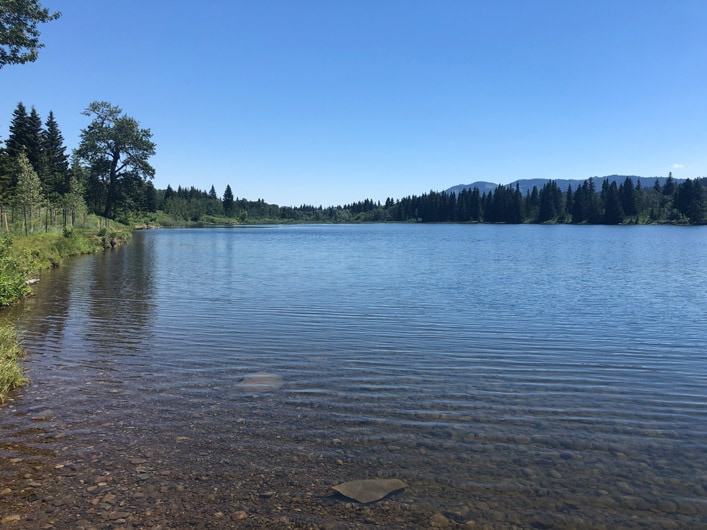
Look at Glenmore on a map.
It is not one uniform piece of water.
There are bays.
Points.
Narrow sections.
Shoreline changes.
Vegetation.
Areas influenced by the Elbow River.
Different depths.
Fish do not use all of that water equally.
Your job is to reduce the amount of water you need to search.
If you are fishing from shore, this becomes even more important because your casting range is limited.
Start With Points
Points are one of the easiest structures for a shore angler to identify.
A point gives you access to several casting directions and may bring deeper water closer to shore.
Fish can travel around the point rather than remaining in the open centre of the reservoir.
Do not stand at the tip and make every cast straight outward.
Fish one side.
Fish across the end.
Then fish the opposite side.
Try different depths.
If wind is pushing into one side of the point, spend extra time there.
Look for Weed Edges
If you are targeting northern pike, vegetation should get your attention.
Pike are ambush predators.
Weeds provide cover for the pike and habitat for the smaller fish they eat.
The problem for shore anglers is that casting directly into thick vegetation can become miserable.
Instead, find the edge.
Cast beside it.
Retrieve along it.
Look for openings.
Look for corners.
Look for places where the vegetation suddenly ends and open water begins.
A spoon travelling along the outside edge of weeds is fishing very different water from a spoon travelling through featureless open water.
Pike Can Be Closer to Shore Than You Think
People fishing Glenmore often try to make the longest cast possible.
That is not automatically a good strategy.
If suitable weeds or other cover exist near shore, a pike can be much closer than you expect.
Make some shorter casts before throwing toward the middle.
Cast parallel to shore.
Fish along vegetation.
Work the water beside a point.
Then gradually cast farther.
A lot of anglers effectively cast over the fish they are trying to catch.
Fish Parallel to the Shoreline
This deserves more attention.
Imagine there is a weed edge running thirty metres along the shoreline.
You cast straight outward.
Your lure crosses that weed edge for perhaps a metre or two.
Then it spends most of the retrieve in open water.
Now make a cast parallel to the weeds.
Your lure stays beside the productive edge for almost the entire retrieve.
Same lure.
Same angler.
Completely different presentation.
This is one of the first things I would try when searching for Glenmore pike.
A Spoon Is a Good Search Lure
You do not need complicated tackle.
A spoon is useful because it casts well and allows you to cover water.
Start with a steady retrieve.
Then experiment.
Let it sink for a couple of seconds.
Retrieve.
Pause.
Speed up.
Slow down.
If weeds are present, keep the spoon high enough that you are working beside them instead of collecting vegetation every cast.
If the water is deeper and relatively clean, let it sink farther.
Use the lure to search different depths.
Spinners Can Work Too
An inline spinner gives you flash and vibration.
That makes it useful when you are trying to find active fish.
Again, do not retrieve exactly the same way all afternoon.
Change depth.
Change speed.
Change casting angle.
If you get a follow without a strike, remember exactly where the fish came from.
That is valuable information.
You found a pike.
Now you can work on getting it to bite.
Soft Plastics Give You More Control
Once you believe fish are in a specific area, a soft plastic can be useful.
You can fish it slowly.
Let it fall.
Work it beside weeds.
Pause it near structure.
A spoon is excellent for searching.
A soft plastic can be excellent when you want to spend more time fishing one promising area.
Do not use so much weight that you spend every retrieve dragging across the bottom.
Do Not Spend the Entire Day Fishing Bottom
This is another mistake.
Pike are not glued to the lakebed.
They may sit within vegetation or cruise above it.
If your lure comes back covered in weeds every cast, you are probably fishing below the useful zone.
Bring it higher.
The goal is often to travel just above vegetation or along its edge.
That keeps the lure visible and available to fish.
Perch Require a Different Mindset
If you are trying to find yellow perch, stop thinking like a pike angler.
Perch often travel in groups.
The challenge is locating them.
Use smaller presentations.
Once you catch one, immediately fish the same general depth and location again.
One perch can tell you where the school is.
Moving away immediately after catching the first fish throws away useful information.
Official material discussing Glenmore has included perch among the reservoir’s sport fish, but old reports should never be treated as proof that a particular shoreline will currently produce them.
Why Glenmore Can Feel Empty
A large urban reservoir can create a frustrating fishing experience.
You know fish exist.
But you might fish several hundred metres of shoreline without putting your lure close to one.
This is especially true if you are limited to shore.
Think about the amount of water available to a fish compared with the tiny amount you can reach with a cast.
That is why structure matters so much.
You need something that gives fish a reason to enter your casting range.
Weeds.
A point.
A drop in depth.
Wind.
Baitfish.
Low light.
Several of those factors together are much more interesting than random open shoreline.
Water Level Changes Matter at Glenmore
Glenmore is not managed purely as a recreational fishing lake.
It is an important part of Calgary’s water system.
The City notes that reservoir levels can be raised or lowered as part of Water Services operations.
That matters to anglers.
A shoreline location that looked perfect on a previous trip may fish differently when the water level changes.
Vegetation may become shallower.
Previously submerged structure may become exposed.
Fish may move.
Access to certain water from shore can change.
Do not assume yesterday’s productive spot will look exactly the same next month.
Falling Water Can Make Shore Fishing More Difficult
Imagine fish were using a weed edge comfortably within casting distance.
The reservoir drops.
Now that edge may be much shallower.
Fish can shift outward with the available habitat.
A boat angler can follow.
A shore angler cannot always do that.
This is one reason Glenmore can feel inconsistent even when you return to exactly the same place.
Pay attention to the water rather than only remembering the location.
Wind Can Make a Huge Difference
A calm afternoon is pleasant.
It is not always what I would choose for fishing.
Moderate wind can break up the surface and push food toward a shoreline.
That can also influence where smaller fish concentrate.
Predators may respond.
If the wind has been blowing steadily toward an accessible section of Glenmore for several hours, I would investigate it.
Especially if that shoreline also contains weeds or a point.
You are beginning to stack useful conditions together.
Do Not Automatically Hide From the Wind
People naturally walk toward the protected side.
Casting is easier there.
The water looks nicer.
But if conditions are safe, the shoreline receiving the wind can be more interesting.
You do not necessarily need to stand directly facing it.
Find an angle where you can fish the affected water without making every cast miserable.
The important part is recognizing that the rougher shoreline deserves attention.
Morning Is Worth the Effort
Glenmore is surrounded by a city of more than a million people.
Human activity is part of the environment.
Early morning gives you quieter shorelines, lower light and often calmer recreational activity.
During summer, the water has also had the entire night to cool.
If I had been repeatedly getting skunked at Glenmore during afternoon trips, changing the time of day would be one of my first experiments.
Get there early.
Fish the same structure.
See what changes.
Evening Can Be Better Than Afternoon
The other obvious window is evening.
As sunlight weakens, fish that were less active or sitting deeper may begin moving.
Predators can become more comfortable using shallower water.
A shoreline that seemed empty at 3 in the afternoon can become much more interesting later.
Instead of spending six slow hours on the reservoir, sometimes two carefully chosen hours are enough.
Cloud Cover Can Extend the Window
Do not assume you need sunrise or sunset every time.
An overcast day can reduce light and keep fish active in shallower water longer.
Add moderate wind and things become even more interesting.
If I were choosing between a bright calm afternoon and an overcast afternoon with manageable wind, I would be more interested in the second option.
Watch for Baitfish
If you see small fish, slow down and investigate.
Predators need food.
Small fish around vegetation, points or shallow structure can be an important clue.
Look for sudden scattering.
Look for swirls.
Look for something attacking the edge of the group.
If minnows suddenly explode away from a weed bed, there may be a reason.
Have a lure ready.
Birds Can Help Too
Pay attention to birds feeding over the water.
Repeated diving in one area can indicate small fish or another concentrated food source.
It does not guarantee that a pike is waiting underneath.
But it is more information than a completely featureless piece of water gives you.
Good fishing decisions often come from combining several small clues.
Do Not Stay in One Spot Because There Is a Bench
This is the urban fishing trap.
There is a convenient trail.
A bench.
A nice opening.
Plenty of room for casting.
So everyone fishes there.
Convenience does not create fish habitat.
If the location does not contain anything interesting and you are not seeing activity, move.
Travel light enough that moving is easy.
Glenmore Rewards Walking
For shore anglers, your legs are your boat.
Use them.
Fish a promising section.
Cover different depths.
Change casting angles.
Nothing happening?
Walk.
Find another point.
Find another weed edge.
Find a change in shoreline.
You may only need to move a few hundred metres to encounter completely different water.
Do Not Expect Every Accessible Shoreline to Produce
This is a major difference between fishing and simply visiting the reservoir.
Much of the shoreline may look attractive.
That does not mean all of it is productive.
You should be selective.
Ask yourself why a fish would be there.
If you cannot answer that question, keep looking.
A Canoe or Kayak Changes Glenmore Completely
The City permits fishing from shore and from allowed non motorized boats. Power motors are prohibited. Fishing from docks and ramps is also prohibited.
That makes a canoe or kayak extremely interesting for anglers.
Suddenly you can reach weed edges that were beyond casting distance.
You can approach points from another direction.
You can search more water.
You can change depth much more easily.
The City also rents canoes and kayaks during the reservoir’s operating season, subject to conditions and availability.
For someone who keeps struggling from shore, getting onto the water may reveal just how much of the reservoir you were unable to reach.
Know Glenmore’s Boat Rules Before Launching
Glenmore has additional municipal rules because it is a drinking water reservoir.
The City says boating is permitted during the operating season from May 1 through October 31, subject to conditions. Approved personal flotation equipment must be worn while on the water. Power motors are prohibited, and boats must use designated launch areas.
Do not assume the rules are the same as another Alberta reservoir.
Check before launching.
You Cannot Fish From the Docks or Ramps
This is an easy rule to miss.
Fishing from Glenmore Reservoir docks and ramps is prohibited by the City.
Fishing is permitted from the shoreline and from permitted non motorized boats.
That means a dock that appears to be the perfect fishing platform is not automatically a legal place to cast.
Choose legitimate shoreline access instead.
Do Not Plan to Ice Fish Glenmore
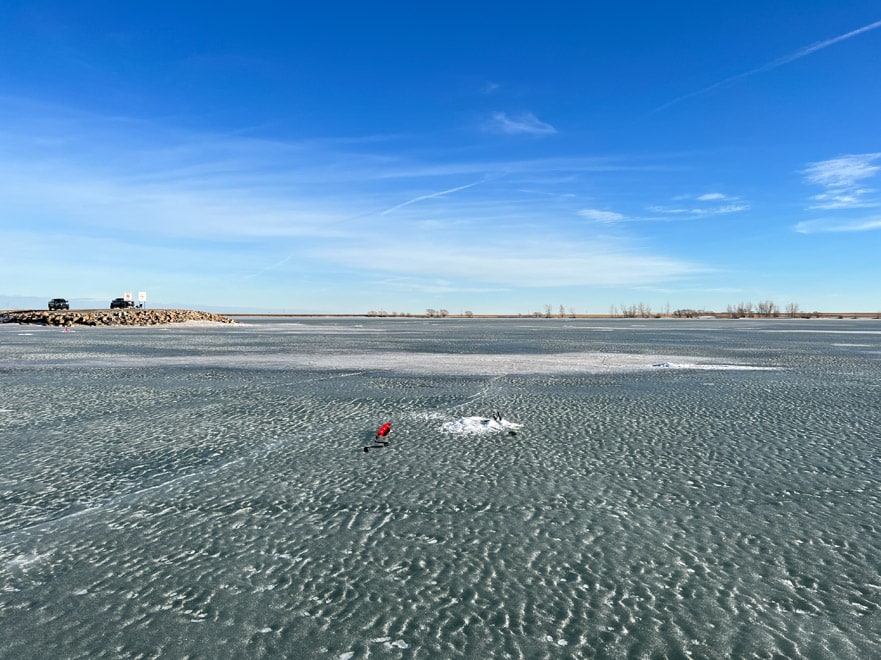
The City prohibits winter activities on Glenmore Reservoir ice, including walking, because moving water and changing reservoir levels make the ice unpredictable.
That makes Glenmore fundamentally different from many Alberta reservoirs people commonly visit for ice fishing.
Do not interpret a frozen surface as permission to walk onto it.
Check Alberta Fishing Regulations Separately
City rules are only one part of the picture.
You also need the current Alberta sportfishing regulations.
The current provincial guide is effective from April 1, 2026 through March 31, 2027 and provides both general rules and waterbody specific regulations.
Check them before fishing.
Do not rely on a Reddit comment from five years ago.
Do not rely on what you remember doing as a teenager.
Do not assume another reservoir has the same limits.
Current rules are what matter.
Is Glenmore Good for Beginners?
It depends what you mean by good.
If you want a guaranteed easy fish, there are probably better choices.
A recently stocked small trout pond gives a beginner a much smaller area to search.
Glenmore is more demanding.
But if you live in Calgary and want to learn how to find fish rather than simply cast into a stocked pond, Glenmore can teach you a lot.
It forces you to think about:
- Structure
- Depth
- Wind
- Vegetation
- Time of day
- Fishing pressure
- Water levels
- Fish movement
Those skills transfer everywhere.
Is Glenmore Worth Driving Across Calgary For?
If your only goal is catching as many fish as possible, I would research several options before automatically choosing Glenmore.
But Glenmore has one major advantage.
It is inside Calgary.
That means you can fish it repeatedly.
You can try morning.
Then evening.
Different wind.
Different shoreline.
Different water levels.
You can learn it.
A supposedly better lake two hours away may get only one visit from you all year.
A difficult reservoir close to home can become productive once you understand it.
What I Would Do on My Next Glenmore Trip
I would not arrive with ten different lure boxes.
I would bring a small selection.
A couple of spoons.
A spinner or two.
Some soft plastics.
Appropriate pike tackle if pike are the target.
Pliers.
Polarized glasses.
Then I would concentrate on water rather than equipment.
I would check the wind before leaving.
Once there, I would find accessible structure receiving useful wind.
I would fish short casts first.
Then farther.
I would work parallel to weed edges.
I would change depth.
I would move if nothing happened.
If I saw baitfish, a follow or a strike, I would slow down and work that area carefully.
I Would Not Judge Glenmore by One Bad Afternoon
This might be the most important part.
Glenmore is exactly the kind of place that can convince someone there are no fish.
You fish one convenient shoreline.
At the wrong time.
Under poor conditions.
At one depth.
Then leave.
That is not really testing the reservoir.
Try morning.
Try evening.
Try wind.
Try another shoreline.
Walk farther.
Fish the weeds.
Fish the points.
If you eventually get a follow or catch a fish, pay very close attention to where it happened.
That fish may teach you more about Glenmore Reservoir than a hundred random casts ever will.
The real challenge at Glenmore is probably not finding a secret lure.
It is figuring out where Calgary’s fish are spending their time when they are not conveniently swimming past the nearest park bench.