You buy the licence.
Read the regulations.
Check whether bait is allowed.
Make sure the lake is open.
Legally, you are ready to fish.
But there is another set of rules nobody gives you with your fishing licence.
How close should you stand to another angler?
Should you tell people exactly where you caught a big trout?
Can you walk through a field to reach a river?
What should you do with discarded line?
Is it rude to fish right beside somebody who is already catching fish?
Should you keep a legal fish when everyone around you is releasing theirs?
A new Alberta angler recently asked exactly this question.
They had moved from Manitoba, wanted to get back into fishing around Calgary and asked what local community rules they should understand beyond the written regulations. The responses mentioned respecting fishing spots, cleaning up garbage, reading regulations carefully and understanding that anglers can be protective of locations they worked hard to find.
There really are unwritten rules in Alberta fishing.
Most are just common sense.
But following them can determine whether you become the angler people are happy to see at the river or the one everybody hopes never comes back.
Give Other Anglers Some Space
This is probably the simplest rule.
If somebody is already fishing an empty section of shoreline, do not walk over and start casting two metres beside them.
Alberta has a lot of water.
Give people room.
Exactly how much room depends on where you are.
At a small stocked pond with twenty people around the shoreline, everyone expects to fish relatively close together.
On a remote foothills stream where somebody walked forty minutes to reach a pool, the expectation is completely different.
Read the situation.
If there is plenty of empty water, use it.
Do Not Cast Across Somebody Else’s Water
This happens surprisingly often.
An angler is working a shoreline from left to right.
Another person arrives and casts directly across the first angler’s retrieve.
Now both lines cross.
Nobody enjoys that.
Watch where other people are casting before you begin.
If they are working a particular current seam, point or weed edge, give them enough room to continue fishing it.
You do not need to claim an entire lake because you arrived first.
But you should be able to complete a cast without somebody repeatedly throwing over your line.
Moving Anglers Need Different Space
River fishing has its own etiquette.
Many trout anglers gradually move through water rather than standing in one location.
They cast.
Take a few steps.
Cast again.
Then continue.
If you see somebody clearly working downstream through a run, do not walk thirty metres ahead of them and immediately begin fishing the water they were approaching.
Move farther away.
Or start behind them.
This matters particularly on smaller Alberta streams where individual pools can be limited.
Ask if You Are Unsure
There is nothing wrong with saying:
Mind if I fish below you?
That five second conversation prevents plenty of irritation.
Most anglers are reasonable.
They may tell you they are staying in one spot.
They may say they are working downstream.
They may even tell you where they just saw a trout rise.
Communication works much better than guessing.
Do Not Crowd Somebody Because They Caught a Fish
This behaviour deserves its own rule.
You are fishing fifty metres away.
Nothing is happening.
Then another angler catches a trout.
Suddenly you move beside them.
Then your friend comes over.
Then someone else notices.
Within ten minutes the person who found the fish has a crowd around them.
Do not do this.
The fish does not belong to the first angler.
But basic courtesy does.
If somebody found productive water, let them enjoy it.
Find your own angle or wait until they move.
Fishing Spots Are a Sensitive Subject in Alberta
Ask an Alberta fishing group:
Where did you catch that?
You may get:
Alberta.
That can frustrate beginners.
But there is a reason anglers become protective of specific locations.
Publicly posting a small productive fishing spot can change it very quickly.
A quiet river access gets shared.
Then shared again.
Then somebody posts exact coordinates.
More people arrive.
Parking becomes a problem.
Garbage appears.
Fish receive much more pressure.
The experience that made the location special begins disappearing.
Recent Alberta discussions show exactly this attitude. Anglers are often willing to give advice about species, tactics and general areas while refusing to publish their favourite precise locations.
Do Not Demand Exact Coordinates
There is nothing wrong with asking for help.
Ask which type of water to look for.
Ask whether trout are using pools or riffles.
Ask whether a particular lake is worth trying.
Ask what lure works.
Ask how to read the regulations.
Those questions help you learn.
But messaging a stranger:
Send me the exact pin where you caught that fish
is different.
Some people will share.
Others will not.
Respect the answer.
If Someone Shares a Spot With You, Think Before Sharing It Again
Suppose a friend takes you to a small stream.
They tell you hardly anybody fishes it.
You catch several beautiful trout.
The next morning you upload the exact location to a large public fishing group.
Technically, you may not have broken any law.
But you probably will not be invited back.
When someone shares a location privately, assume it was shared with you rather than the entire internet unless they clearly say otherwise.
This Does Not Mean Public Water Is Private Property
There is another extreme.
Nobody owns a fishing hole simply because they have been fishing it for fifteen years.
Legal public fishing water remains public.
You do not get to threaten another angler because they discovered a location you like.
You do not get permanent ownership of a river bend.
Courtesy works both ways.
Give people reasonable space.
Do not deliberately crowd them.
And accept that other anglers may eventually discover the same water.
Access Is Where Etiquette Becomes Law
Finding fish does not automatically give you the right to cross whatever land lies between you and the water.
The 2026 Alberta fishing regulations remind anglers that permission is required before entering or crossing private land, Indian reserves, Métis settlements and agricultural public land under lease.
This is one of the most important things new Alberta anglers need to learn.
A river appearing on a map does not mean every route to that river is public.
Do Not Climb a Fence Because You Can See the River
You are driving.
You see perfect water.
There is a field between the road and the river.
There is a fence.
Do not assume:
The river is public, so I can walk through the field.
The land may be private.
It may be agricultural public land with access conditions.
You need to determine what land you are crossing.
For private property, the owner can deny access.
For agricultural public land, Alberta requires recreation users to contact the leaseholder and follow the applicable access process.
Leave Gates the Way You Found Them
If you have legitimate permission to cross agricultural land, respect the property.
If a gate was closed, close it.
If it was open, leave it as instructed.
Do not disturb livestock.
Do not drive where you were told to walk.
Do not damage crops.
One irresponsible visitor can make access harder for every angler who comes afterward.
That is why access etiquette matters beyond your own fishing trip.
Do Not Block Farm Roads or Boat Launches
Parking is another surprisingly common problem.
You find a good access point.
There are already several vehicles.
Do not park in a way that blocks a gate, launch, road or turnaround.
A farmer may need access.
Emergency vehicles may need access.
Someone towing a boat needs room to turn.
Walk an extra few minutes if necessary.
A slightly longer walk is better than returning to an angry landowner or finding your vehicle trapped.
Take Your Garbage Home
This one should not need explaining.
Yet almost every popular fishing area eventually seems to collect:
Empty worm containers.
Fishing line.
Cans.
Food wrappers.
Hook packages.
Cigarette butts.
Broken chairs.
Discarded bait.
A recent Alberta discussion about fishing etiquette specifically mentioned garbage as one of the reasons anglers become reluctant to publicly share productive spots.
If you carried it in, you can carry it out.
Fishing Line Is Worse Than Ordinary Garbage
A food wrapper looks ugly.
Discarded fishing line can injure wildlife.
Birds can become tangled.
Animals can ingest it.
Hooks may remain attached.
People and pets can encounter it around popular shorelines.
Keep old line in a pocket or container until you can dispose of it properly.
If you see several metres of abandoned line beside your fishing spot, picking it up takes almost no effort.
You were going back to the vehicle anyway.
Pick Up More Than You Brought
You do not have to spend your fishing trip cleaning an entire shoreline.
But if there is a can beside your tackle box, grab it.
If there is fishing line caught in a bush, remove it.
If every angler took home one piece of somebody else’s garbage, popular Alberta fishing access would look considerably better.
You also remove one of the strongest arguments landowners have for restricting recreational access.
Do Not Leave Fish Guts at Popular Access Points
You keep a legal fish.
Clean it.
Then leave the head, guts and skin beside the parking area.
Now everybody else gets to smell it.
Animals drag the remains around.
Dogs find them.
People step on them.
Alberta recommends using fish cleaning stations where available and putting fish parts into garbage rather than disposing of them back into water.
Process your catch responsibly.
Respect Fish You Intend to Release
This is probably the most important fishing etiquette of all.
Do not treat a fish badly simply because it is not going into the cooler.
Keep handling short.
Wet your hands.
Have your pliers ready.
Take your photograph quickly.
Release the fish.
Do not spend several minutes getting ten different pictures while a trout lies on dry rocks.
A fish does not become more impressive because the photography session lasted longer.
Do Not Lecture Every Angler Who Keeps a Fish
The opposite problem exists too.
You watch somebody legally keep a stocked rainbow trout.
Then you tell them they are destroying the fishery.
If the fish is legal to harvest and the water is managed to provide harvest opportunity, they have not done anything wrong.
Some anglers release everything.
Some enjoy eating fish.
Both can participate responsibly.
The regulations determine what harvest is legal.
Personal preference does not create a new law.
But Do Not Keep Fish You Will Not Use
Legal does not automatically mean sensible.
If you keep fish, have a reason.
Take them home.
Clean them.
Eat them.
Do not kill a fish because you can and then decide at the end of the day that you do not want it.
Harvest should be intentional.
Know the Fish Before You Decide
This matters particularly in Alberta where similar looking species can have completely different regulations.
Bull trout must be released.
Native suckers can be confused with invasive Prussian carp.
Trout species can be difficult for beginners to distinguish.
If you do not know what the fish is, release it.
Trying to learn fish identification is good etiquette because it prevents unnecessary harm as well as legal mistakes.
Do Not Tell Other Anglers Their Legal Technique Is Wrong Because You Dislike It
Fly anglers sometimes look down on spinning gear.
Lure anglers sometimes mock bait fishing.
Boat anglers complain about shore anglers.
Shore anglers complain about boats.
None of this catches more fish.
If somebody is fishing legally and responsibly, let them fish.
A worm beneath a float can be completely appropriate where bait is permitted.
A spinner can catch excellent trout.
A fly rod is not a requirement for appreciating a river.
Different methods are part of fishing.
Boat Anglers Need to Respect Shore Anglers
If someone is casting from shore, do not drive your boat directly through the water in front of them when you have an entire lake available.
Give them room.
Shore anglers may have only a small amount of reachable water.
A boat gives you considerably more freedom to move.
Use it.
The same applies to wakes.
Alberta’s boating guidance asks users to watch wakes, keep motorized activity away from shore where appropriate, minimize noise and use established launch areas.
Shore Anglers Need to Respect Boat Launches
The courtesy goes both ways.
Do not set up your entire fishing camp across a busy boat launch.
Do not cast repeatedly across the path where boats are entering and leaving.
A launch exists primarily to get watercraft into and out of the water.
If fishing is permitted nearby, position yourself where you are not making every launch an obstacle course.
Do Not Fish From Docks Where Fishing Is Prohibited
A dock looks perfect.
That does not mean fishing is allowed from it.
Some municipal docks and boat launch structures specifically prohibit fishing because hooks and lines interfere with boaters.
Read the signs.
Do not argue that the fish were there first.
Access rules still apply.
Keep Noise Reasonable
Fishing does not require absolute silence.
You can talk.
Laugh.
Bring friends.
Enjoy yourself.
But there is a difference between conversation and turning a quiet lake into an outdoor nightclub.
Alberta’s boating guidance specifically asks users to keep boat noise and music reasonable.
People go fishing partly because they want to be outside.
Let everyone enjoy the water.
Dogs Need Etiquette Too
Your dog may be friendly.
The other angler does not know that.
Do not let it charge through somebody’s tackle.
Do not let it shake water over another person’s gear.
Do not let it eat somebody’s bait.
And definitely do not allow it to chase wildlife around the shoreline.
If the location requires dogs to be controlled, follow the rules.
Even where regulations are less specific, control your animal around other anglers.
Clean Your Gear Between Waters
This used to sound like something only boat owners needed to worry about.
It is not.
Mud and water on waders, kayaks, nets and other fishing equipment can move invasive species and fish diseases between waterbodies.
Alberta asks anglers and boaters to clean, drain and dry equipment after use. It is also illegal to transport a watercraft on a roadway with the drain plug still installed.
Good fishing etiquette includes protecting the next lake from whatever was in the previous one.
Do Not Dump Bait Into the Water
You finish fishing.
There are minnows or other bait left.
Dumping them into the lake is not cleaning up.
It can move organisms and disease.
Dispose of unused bait according to Alberta’s regulations and never release live fish into another waterbody.
Your convenience at the end of the day is not worth creating a biological problem that lasts for years.
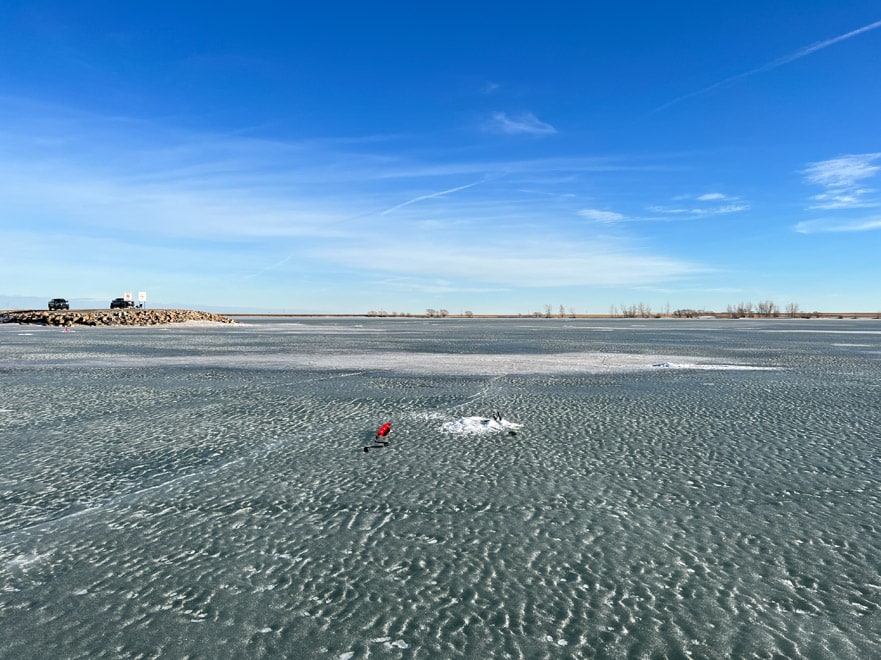
Give Ice Anglers Room Too
Winter creates its own version of crowding.
A lake may contain kilometres of ice.
There is rarely a good reason to drill a hole one metre from a stranger unless they invited you.
If somebody has tip ups out, look for them before driving or walking through the area.
One recent Alberta etiquette discussion even included the very practical request not to drive so close to someone’s tent that you run over a tip up.
That seems like a reasonable standard.
Do Not Park Your Vehicle Beside Somebody’s Ice Hole
Vehicles create noise, exhaust and safety concerns.
If another angler is clearly fishing an area, give them space rather than parking directly beside their setup.
And remember that no fishing spot is worth taking unnecessary ice risks.
Good etiquette does not matter much if you ignore basic safety.
Help People Who Are Clearly New
There is a difference between protecting a favourite fishing spot and refusing to help anybody.
If somebody is struggling to cast, explain something.
If they caught a fish they cannot identify, help them if you are confident.
If they are about to make an obvious regulation mistake, politely point it out.
You do not have to give them the coordinates of your best trout stream.
You can still help them become a better angler.
The healthier the fishing community becomes, the better it is for everybody using the resource.
Do Not Pretend to Know Regulations You Have Not Checked
Bad information can be worse than no information.
Someone asks whether bait is legal.
You vaguely remember using worms there ten years ago.
Do not confidently tell them it is fine.
Tell them to check the current regulation.
Fishing rules change.
A well meaning guess can result in somebody receiving a fine.
Read the Current Regulations Yourself
This is the most repeated piece of advice in Alberta fishing discussions for a reason.
Do not rely entirely on your friend.
Do not rely entirely on a social media comment.
Do not rely on what was legal last season.
Read the current rules for the exact waterbody.
That was also one of the first responses to the recent Alberta newcomer asking about local fishing etiquette.
Being able to check your own regulations is one of the skills that turns a beginner into an independent angler.
Do Not Burn a Small Spot for Internet Attention
You catch a beautiful trout.
Posting the fish is fine.
But think about what else is visible.
A distinctive bridge.
A road sign.
A mountain.
A campground sign.
Exact map coordinates.
Sometimes people unintentionally reveal far more than they intended.
For a massive reservoir, this may not matter much.
For a tiny stream containing vulnerable trout, it can matter a lot.
There is nothing wrong with saying the fish came from southern Alberta.
You do not owe the internet the exact rock you were standing on.
Share Knowledge More Freely Than Locations
This is probably the best compromise.
Teach someone how to find trout water.
Explain what a seam looks like.
Show them how to fish a spoon.
Explain how wind affects a lake.
Help them understand stocking reports.
Show them how to identify a bull trout.
Those skills can help them for the rest of their fishing life.
Giving someone one exact fishing coordinate helps them until that spot stops producing.
Teach the method.
Let them find their own water.
Leave the Place Looking Like You Were Never There
This is the unwritten rule that covers nearly everything.
No line in the bushes.
No worm container beside the lake.
No beer cans.
No damaged fences.
No open gates.
No fish carcasses at the parking area.
No fire left burning.
No bait dumped into the water.
No reason for the next person to know you were there other than perhaps a few footprints.
Alberta has millions of acres of public land and an enormous network of lakes, rivers and streams, but access depends partly on people using those places responsibly. The provincial fishing regulations explicitly connect continued fishing access with courtesy and responsible conduct around fishing waters.
The Unwritten Rules Are Mostly About Not Ruining Fishing for the Next Person
That is really what Alberta fishing etiquette comes down to.
Give people space.
Respect private property and agricultural access.
Keep good spots private when someone trusted you with them.
Help beginners without feeling obligated to publish every place you fish.
Handle fish properly.
Harvest legally and intentionally.
Take garbage home.
Clean your equipment before moving to another waterbody.
Do not crowd boats, shore anglers or ice anglers.
And remember that you are rarely the last person who will ever fish that piece of water.
The angler arriving tomorrow deserves to find the shoreline without your fishing line in the bushes.
The landowner deserves to find the gate the way it was left.
The next person deserves a fair chance to fish without finding your garbage.
And the fish deserves better than being badly handled simply because you wanted another photograph.
Follow the written regulations because they are the law.
Follow the unwritten ones because they are how good fishing places stay good.

Recent Fishing Reports