You finally catch the fish you have been waiting for.
Maybe it is a big northern pike.
A beautiful Bow River trout.
A thick walleye.
Or simply your first fish.
You get excited.
The fish comes into the net.
Now the clock starts.
Phone comes out.
Pliers are somewhere in the tackle box.
Your friend wants a picture.
The fish starts flopping.
Someone puts it on the grass so it will stop moving.
Then another photo.
Then you carry it back to the water and watch it swim away.
Everything seems fine.
But watching a fish disappear beneath the surface does not automatically mean that fish survived.
How you handle a fish during the minute after catching it can be just as important as how you fought it.
Alberta specifically identifies air exposure, exhaustion, warm water, poor hook removal and damage to the protective mucus covering as factors that can reduce survival after release.
The good news is that proper fish handling is not complicated.
Most of it comes down to being prepared before the fish ever reaches you.
Keep the Fish in the Water
If you remember only one thing from this article, make it this.
Keep the fish wet.
Alberta identifies air exposure as a significant contributor to mortality in released fish and says the best practice is keeping the fish in the water as much as possible.
Fish breathe underwater.
That sounds painfully obvious.
Yet anglers routinely remove fish from water and then spend several minutes acting as though breathing has temporarily become optional.
Imagine finishing a hard sprint and immediately having somebody cover your mouth and nose while taking pictures.
That is roughly the worst possible time to stop breathing.
A fish has just fought against your rod.
Its energy use has increased.
Then it gets lifted into an environment where its gills cannot function normally.
Keep that period as short as possible.
The Net Can Become Your Holding Area
A good landing net makes this much easier.
Land the fish.
Keep the net in the water.
Let the fish remain submerged while you organize everything.
Now you have time to:
- Put down the rod
- Grab the pliers
- Prepare the camera
- Wet your hands
- Get the measuring device ready
The fish can continue breathing while you do all of that.
Alberta recommends using a landing net as part of preparing for quick and safe fish handling.
This is much better than placing a fish on shore while you search through your backpack.
Rubber Nets Are Worth Having
Traditional knotted nets can be rough on fish.
Hooks also become tangled in them easily.
A rubber mesh landing net is much easier to work with.
It supports the fish.
It stays wet.
Hooks generally come free more easily.
And the smooth material is less abrasive against the fish’s skin.
Alberta includes rubber mesh landing nets among recommended fish handling equipment.
If you release a lot of fish, a decent net is one of the best equipment upgrades you can make.
Wet Your Hands Before Touching the Fish
Fish are covered by a protective mucus layer.
Anglers usually call it slime.
That word makes it sound useless.
It is not.
That mucus is part of the fish’s natural protection.
Dry hands can remove more of it than wet hands.
Alberta recommends completely wetting your hands before handling a fish and warns against damaging the protective mucus surface.
So before lifting a fish:
Put your hands in the water.
Then handle it.
It takes two seconds.
Do Not Put Fish on Grass
This is one of the most common fish handling mistakes.
The fish comes out of the water.
It starts moving.
The angler places it on the grass.
Now it is easier to take a photograph.
The problem is that grass, sand, gravel and dirt can all remove protective mucus and physically damage the fish.
The fish may also thrash against the ground.
That can damage fins.
Eyes.
Gills.
Scales.
And the longer the fish lies there, the longer it cannot breathe normally.
If you intend to release the fish, the ground should not be your photography table.
Rocks Are Even Worse
A fish flopping against rocks can injure itself very quickly.
This matters particularly with trout.
They can look surprisingly strong when swimming through current.
Out of water, they are a vulnerable animal throwing their body against whatever surface you gave them.
If the shoreline is rocky, leave the fish in the net.
The picture may not look as dramatic.
The fish has a much better chance of surviving.
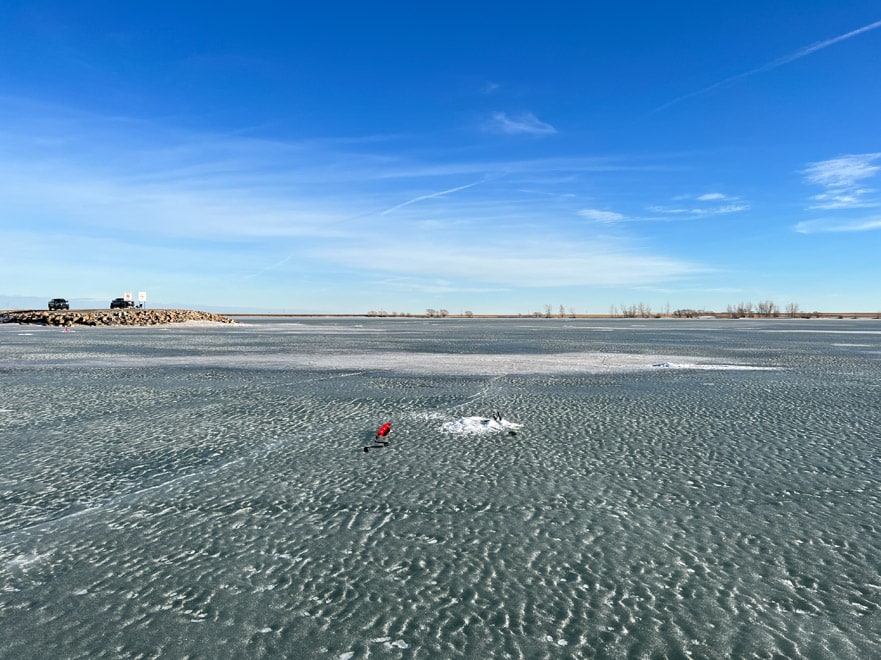
Snow and Ice Are Not Safe Fish Mats Either
Winter creates another version of the same problem.
People catch a fish through the ice and automatically place it on the snow.
It looks clean.
It looks soft.
That does not make it harmless.
Alberta specifically tells ice anglers not to place fish directly on snow or ice.
Freezing air temperatures and physical contact can damage sensitive tissues including eyes and gills.
If the fish is going back, keep it wet and minimize exposure.
A fish living in water near freezing is still not designed to lie in freezing air.
Have Your Pliers Ready Before You Cast
This simple habit makes an enormous difference.
You hook a fish.
Land it.
Then begin digging through your tackle box for pliers.
Wrong order.
Your pliers should already be somewhere accessible.
Pocket.
Vest.
Boat console.
Kayak crate.
Beside the ice hole.
Somewhere you can reach immediately.
Alberta recommends needle nose pliers or similar hook removal tools so hooks can be removed quickly without unnecessary handling.
The fish should not have to wait while you remember where you packed them.
Do Not Tear a Hook Out
Sometimes the hook comes out instantly.
Other times it does not.
Do not turn the removal into surgery.
If the hook is badly positioned, use pliers.
Control the hook.
Back it out carefully.
Alberta specifically advises anglers never to tear hooks from fish.
A few extra seconds of careful hook removal are better than ripping tissue because you want the fish gone quickly.
Deeply Hooked Fish Need a Different Approach
Sometimes a fish swallows the hook deeply.
You cannot reach it safely.
Trying to retrieve it might require damaging the throat, gills or internal tissue.
In that situation, Alberta recommends cutting the line rather than tearing deeply embedded hooks from the fish.
This can feel wrong.
You are leaving a hook behind.
But digging aggressively inside the fish may create much more immediate damage.
The goal is not retrieving fifty cents worth of tackle.
The goal is getting the fish back into the water alive.
Never Put Your Fingers Into the Gills
Gills are delicate.
They are also essential.
Do not use them as handles.
Alberta specifically warns against putting fingers into the gills of fish that are being released.
This mistake happens most often with larger fish because anglers are looking for a secure grip.
Use proper support instead.
Avoid the Eyes Too
This sounds obvious.
Yet when a fish is moving, anglers sometimes grab wherever they can.
Alberta also specifically warns against contact with the eyes.
A fish that is difficult to control should go back into the water or net.
Do not squeeze harder because the picture is taking too long.
Support Bigger Fish Horizontally
Large fish need support.
If you lift a substantial pike or trout vertically from one point, gravity places stress on the body in a way the fish does not normally experience underwater.
A much better approach is to support the fish horizontally.
One hand controls near the head.
The other supports the belly toward the rear of the fish.
Keep the fish level.
Do not squeeze.
This also produces a much better photograph.
Pike Need Special Attention
Northern pike look indestructible.
They have teeth.
Hard heads.
Strong bodies.
They survive cold Alberta winters.
They attack huge lures.
That toughness creates bad habits among anglers.
A pike gets treated like a piece of equipment.
Dropped onto shore.
Held badly.
Allowed to flop around.
Kept out of water while somebody tries to find a phone.
Pike deserve the same basic handling care as any other released fish.
Tough does not mean invincible.
Learn How to Hold a Pike Before Catching One
This is worth practising mentally before your first larger pike.
Do not suddenly improvise while staring at a mouth full of teeth.
A proper pike grip controls the lower jaw area without inserting your hand into the gills themselves.
Then the second hand supports the body.
If you are uncomfortable doing this, keep the fish in the net.
There is absolutely nothing wrong with taking a net photograph.
Long Pliers Are Essential for Pike
A pike can inhale a lure much farther than you expected.
Short pliers force your fingers closer to teeth.
Long needle nose pliers give you more reach.
They also let you control hooks more safely.
If you regularly target pike, I would rather carry proper long pliers than another five lures.
Hook removal equipment is part of fishing equipment.
Treble Hooks Can Become a Mess
A pike with a large crankbait can have several exposed hook points moving beside your hands.
The fish twists.
One treble remains in the mouth.
Another swings freely.
This is where anglers get hooked.
Keep the fish controlled in the net.
Use pliers.
Take your time with the dangerous part.
You want quick fish handling.
You do not want careless fish handling.
A hook buried in your finger does not help the fish either.
Trout Need Particularly Gentle Handling
Trout can be sensitive to poor handling.
This is especially important in Alberta rivers where the same fish may be caught multiple times during its life.
Alberta’s Native Trout Recovery Program notes that improper handling can cause injuries, reduce fitness and contribute to mortality after release. Fish experiencing warm water, low flow or spawning stress can be particularly vulnerable.
If you fish trout regularly, careful handling should become automatic.
Keep them wet.
Wet hands.
Quick hook removal.
Quick photograph.
Release.
Do Not Squeeze Trout
A trout starts moving in your hands.
Your natural reaction is to squeeze harder.
Try not to.
Alberta specifically warns anglers against squeezing fish during handling.
You are dealing with a living animal whose organs are supported differently underwater.
If the fish becomes difficult to control, lower it back into the net.
Reset.
Try again.
The Best Trout Picture May Take Five Seconds
Have the camera ready first.
Lift the fish.
Photo.
Back into water.
That is the entire sequence.
You do not need:
A horizontal picture.
Vertical picture.
Picture facing left.
Picture facing right.
Picture with your friend.
Picture without your friend.
Picture beside the rod.
Picture beside the river sign.
If the fish is going back, the photography session should not become the longest part of the catch.
Prepare the Camera While the Fish Is Still Underwater
This is another recommendation directly supported by Alberta’s fish handling guidance.
Do not lift the fish and then unlock your phone.
Then open the camera.
Then wipe the lens.
Then change modes.
Then ask someone to move closer.
Do all of that first.
The fish can wait underwater in the net.
Once everything is ready, lift it briefly.
Video Can Make Fish Photos Easier
If you are fishing alone, trying to set a timer can turn fish handling into a disaster.
One easier approach is video.
Position the phone before lifting the fish.
Start recording.
Lift the fish briefly.
Return it to the water.
Then take a still image from the video later.
You may not get the absolute highest resolution photograph.
You will probably handle the fish much faster.
That is a good trade.
Not Every Fish Needs a Picture
You catch a small trout.
You already photographed three similar trout that day.
Release it.
Sometimes the fastest possible handling is no handling.
Remove the hook in the water.
Let the fish swim away.
You do not need photographic evidence of every fish you catch.
Fight the Fish Efficiently
Fish handling begins before the fish reaches the net.
Alberta advises anglers not to play fish to exhaustion because prolonged fights increase stress and can increase the chance of mortality.
That does not mean violently dragging every fish in.
It means using suitable tackle.
Control the fish.
Land it efficiently.
A twenty minute battle on extremely light line may sound sporting.
The fish may experience it differently.
Match Your Tackle to the Fish
If you expect large pike, bring equipment capable of landing them.
If you are fishing for large river trout, use tackle that gives you reasonable control.
Ultralight equipment is fun.
There is a point where light tackle becomes unnecessarily difficult for the fish you are targeting.
The goal should be a controlled fight rather than intentionally exhausting the fish.
Warm Water Changes Everything
This is one of the biggest fish handling issues in summer.
Warm water contains less dissolved oxygen.
Fish are already dealing with increased physiological stress.
Then you hook them.
Fight them.
Handle them.
Expose them to air.
Alberta notes that many trout species are most comfortable around 15°C and warns that elevated water temperatures can increase stress and reduce survival after release.
During hot conditions, fish handling becomes even more important.
Morning Can Be Better for the Fish Too
Anglers often fish early during summer because fish may bite better.
There is another advantage.
Water is generally cooler after night.
That can reduce stress on cold water fish compared with catching them during the hottest part of the afternoon.
Alberta recommends fishing cooler periods such as morning or evening when water temperatures become elevated.
This is not just about catching more fish.
It can help the fish survive afterward.
A Fish Swimming Away Slowly May Need Time
You lower the fish into the water.
It does not immediately disappear.
Do not panic.
Support it gently.
Keep it upright.
Give water time to move across the gills.
Alberta recommends gently holding a tired fish and moving it slowly through the water if necessary until it becomes capable of swimming away.
Release it when the fish is ready.
Do Not Throw Fish Back
This is another surprisingly common habit.
Fish comes out.
Picture.
Then the angler throws it several feet back into the lake.
Do not do that.
Alberta specifically advises releasing fish gently rather than throwing them.
Lower the fish into the water.
Support it.
Let it leave under its own power.
There is no reason to turn the release into a basketball shot.
Headfirst Is Better Than Belly Flop
If you are releasing a fish from slightly above the water and cannot lower your hands completely, guide it headfirst.
Alberta recommends gentle headfirst release for ice fishing as well.
The ideal situation is still keeping the fish in contact with the water.
But if the fish needs to reenter, do it gently.
Deep Water Creates a Completely Different Problem
This is particularly important for Alberta walleye and yellow perch anglers.
Fish living at depth experience higher water pressure.
When a fish is brought rapidly toward the surface, gases inside its swim bladder can expand.
The fish cannot always adjust quickly enough.
This is called barotrauma.
Alberta warns that walleye and yellow perch caught deeper than about seven metres can have reduced survival after being brought to the surface and released.
Seven metres is only about twenty three feet.
That is not particularly deep by Alberta walleye fishing standards.
The Fish May Look Swollen
A fish suffering from pressure change can show obvious symptoms.
The body may feel unusually hard.
The swim bladder may become visible near the mouth.
The fish may struggle to swim downward after release.
This is not simply the fish being tired.
The rapid pressure change has created an internal problem.
That means catch and release fishing at depth deserves more thought than many anglers give it.
Deep Walleye Fishing Can Create Delayed Mortality
You catch a walleye from deep water.
Release it.
It swims awkwardly.
Maybe it disappears eventually.
That does not automatically mean everything is fine.
Barotrauma can cause internal injuries.
Alberta specifically identifies pressure change as a serious survival issue for walleye and perch caught from deeper water.
If you are planning to release fish, shallower water can provide a much better situation.
Do Not Puncture the Swim Bladder
Some anglers have historically used a practice sometimes called fizzing.
A needle is inserted into the fish to release gas from the swim bladder.
Alberta advises against this practice, stating that it causes additional injury and does not improve survival.
Do not perform amateur surgery on the fish.
The better solution is avoiding situations likely to create severe barotrauma in the first place.
Perch Anglers Should Think About Depth Too
Barotrauma discussion usually focuses on walleye.
Yellow perch can experience the same problem.
This matters because perch often school in deeper water.
Once an angler finds a school, they may catch fish repeatedly from the same depth.
If those perch are being released, the cumulative problem can become significant.
Alberta includes both walleye and yellow perch in its deep water handling warning.
Ice Fishing Does Not Remove the Problem
Ice anglers often fish vertically in deep water.
That makes bringing fish rapidly to the surface extremely easy.
The hole may be directly above the school.
Drop.
Catch.
Reel straight up.
Repeat.
The fact that it is winter does not eliminate pressure change.
Depth is still depth.
If you intend to release perch or walleye, think about how deep you are fishing.
Winter Adds Another Problem
Freezing air.
A fish comes through the hole from water near freezing.
Then it lies on ice while you prepare the camera.
Alberta warns that exposure to freezing temperatures can damage fish eyes and gills and recommends keeping fish off the snow and ice when releasing them.
Have everything ready.
The colder the air, the less time I want that fish exposed.
Fish Handling Should Get Faster With Experience
Beginners are naturally slow.
That is fine.
You are learning.
But prepare.
Practise opening the net.
Know where the pliers are.
Know how your camera works.
Learn how to hold the species you are targeting.
Learn how the hooks on your favourite lure behave.
Every fish teaches you something.
Eventually the process becomes smooth.
Land.
Unhook.
Photo if wanted.
Release.
Your Equipment Should Be Ready Before the Bite
For fish you expect to release, I would want:
- Rubber landing net
- Long needle nose pliers
- Line cutters
- Camera ready
- Measuring device if you care about the length
- Wet hands before lifting
That small amount of preparation solves most fish handling problems.
You do not need complicated equipment.
You need the right equipment within reach.
Cutting the Line Can Sometimes Be the Better Decision
Anglers hate losing hooks.
We paid for them.
We want them back.
But there are times when retrieving the hook creates far more damage than leaving it.
If the hook is deeply embedded and removing it requires tearing tissue, Alberta recommends cutting the line and releasing the fish rather than forcing removal.
The hook is replaceable.
The fish is the valuable part.
Barbless Hooks Can Make Release Easier
You do not need a barb to catch fish effectively if you maintain tension.
A barbless hook usually comes out more easily.
That can reduce handling time.
It can make hook removal simpler while the fish remains in the water.
Alberta notes that barbless hooks can help anglers shorten handling and air exposure even though they do not automatically guarantee lower mortality in every situation.
If you release most of what you catch, pinching down the barb is worth considering.
Barbless Hooks Make Anglers Safer Too
There is another advantage.
Eventually, almost every serious angler hooks something they did not intend to hook.
A jacket.
Net.
Seat.
Finger.
A barbless hook is much easier to remove.
That becomes especially relevant while handling pike with multiple treble hooks.
Fish handling becomes easier when you are not terrified of the free hook swinging beside your hand.
A Fish Can Look Fine and Still Die Later
This is why fish handling matters.
Mortality is not always immediate.
A badly handled fish can swim away.
Then die later from:
Exhaustion.
Internal injury.
Gill damage.
Stress.
Temperature stress.
Predation while weakened.
Alberta’s native trout recovery information specifically notes that catch and release stress can reduce fitness and potentially make fish more vulnerable even when they initially survive the capture.
The release itself is not proof of success.
The goal is giving the fish the best chance afterward.
Catching the Same Fish Repeatedly Adds Up
On heavily fished water, one fish may be caught several times.
Alberta notes that repeated capture can occur in areas experiencing high fishing pressure.
Imagine a trout surviving five anglers in one summer.
One angler handles it perfectly.
One keeps it out of water for a minute.
Another drops it.
Another squeezes it.
Another catches it during very warm water.
Each individual event may appear minor.
Together they matter.
That is one reason good fish handling becomes especially important on popular Alberta fisheries.
You Do Not Need to Baby Every Fish for Five Minutes
There is another mistake at the opposite extreme.
An angler thinks proper release means holding a fish in the water forever.
Usually it does not.
If the fish is upright, responsive and trying to leave, let it go.
Do not restrain a strong fish unnecessarily.
Support a tired fish when needed.
Release an energetic fish when it is ready.
The fish will tell you.
Watch the Tail
A fish regaining strength often begins pushing against your hand.
The tail becomes active.
The body becomes more stable.
It starts trying to swim forward.
That is what you want.
Loosen your grip.
Let the fish leave.
Do not pull it back for another picture because it suddenly looks energetic again.
The photography session is over.
Some Fish Barely Need Handling
Small fish can often be released without ever being lifted.
Bring the fish beside you.
Grab the hook with pliers.
Turn it.
Fish drops free.
Done.
This is one of the gentlest releases possible.
No picture.
No touching.
No air exposure.
No drama.
The Best Release Often Looks Boring
There is no dramatic slow motion toss.
No fish lying beside the rod for scale.
No five minute photography session.
The fish comes into the net.
The hook comes out.
Maybe there is one quick picture.
The fish swims away.
That is it.
Good fish handling is usually uneventful.
That is exactly what you want.
What I Would Do With a Large Pike
Keep the pike in a rubber net in the water.
Get the pliers ready.
Remove the lure while the fish remains supported whenever possible.
Prepare the camera before lifting.
Wet my hands.
Support the pike horizontally with two hands.
Take one quick photograph.
Return it immediately.
Support it until it swims away.
The bigger the fish, the less interested I am in experimenting with photography.
Large fish took years to become large.
What I Would Do With a Trout
I would try to remove the hook without lifting it at all.
If I wanted a photograph, the camera would already be ready.
Wet hands.
Quick horizontal lift.
Photo.
Back into the water.
No rocks.
No grass.
No squeezing.
No fingers near the gills.
Particularly during warm conditions, I would make the process as quick as possible.
What I Would Do With Walleye or Perch
First I would think about depth.
If I planned to release fish, I would prefer catching them shallower rather than repeatedly pulling them from deep water.
Once landed, the same principles apply.
Keep them wet.
Remove hooks efficiently.
Limit air exposure.
Release gently.
The best fish handling technique cannot completely undo severe pressure damage caused before the fish reached the surface.
You Can Take Great Fish Photos Without Abusing the Fish
Fish care and photography are not enemies.
Prepare first.
Choose the background before lifting the fish.
Know where the camera is.
Have the person taking the photograph ready.
Lift.
Smile.
Click.
Release.
Five good seconds can produce a better photograph than two chaotic minutes.
The difference is preparation.
The Fish Does Not Care About Your Social Media
This is the easiest standard to remember.
If the picture is not ready, the fish goes back into the water.
If the phone will not unlock, the fish goes back into the water.
If your friend missed the photograph, the fish goes back into the water.
You already had the experience.
You caught it.
A picture is optional.
The fish surviving is more important than proving the catch happened.
Build the Release Into the Fishing Trip
Do not treat fish handling as something you figure out after catching the fish.
Before casting, ask:
Where is my net?
Where are my pliers?
How will I land a fish here?
Can I reach the water safely?
Where will I keep the fish while preparing a photograph?
What happens if I catch something much larger than expected?
Answer those questions before the bite.
Then when the fish finally appears, you can actually enjoy the moment instead of scrambling.
A good release starts long before the fish reaches your hands.

Recent Fishing Reports