You find an Alberta trout pond on the stocking map.
It was stocked with thousands of rainbow trout last spring.
Now another spring has arrived.
So what happened to all those fish?
Did anglers catch them?
Did they survive under the ice?
Did the pond winterkill?
And if some trout survived, could there be much bigger fish swimming around than the ones being stocked this year?
These questions come up constantly around Alberta stocked ponds.
A recent July 2026 discussion asked whether the tiger trout in Bear Pond were still worth hiking in for or whether the pond continued to suffer winterkill. (Reddit)
The answer depends completely on the waterbody.
Some Alberta stocked trout ponds are basically designed around annual stocking.
Others can support trout through several winters.
Some are actively aerated specifically to help fish survive throughout the year.
And a pond that successfully overwintered trout last year can still have problems this year.
Understanding that difference can completely change how you read Alberta’s stocking reports and how you choose where to fish.
Yes, Stocked Trout Can Survive an Alberta Winter
The first misconception is that stocked trout automatically die when winter arrives.
They do not.
Rainbow trout, brook trout, brown trout and tiger trout are all capable of surviving cold water.
Cold itself is usually not the main problem.
The problem is oxygen.
A trout can live perfectly well beneath ice if enough dissolved oxygen remains in the water.
If oxygen falls too low, fish begin to struggle.
Eventually they die.
This is what anglers usually mean when they talk about winterkill.
What Actually Causes Winterkill?
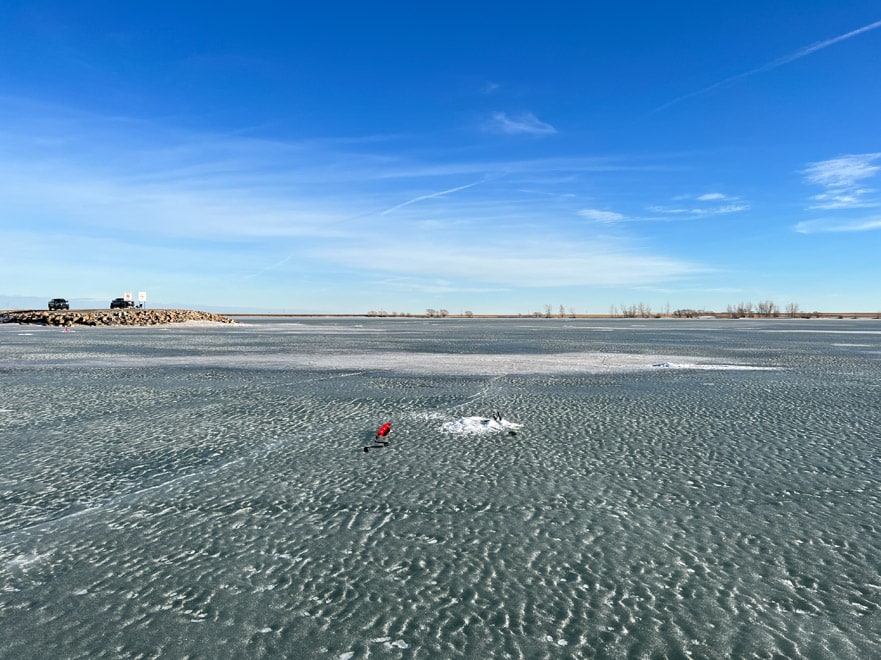
Imagine a shallow Alberta pond in December.
Ice forms across the surface.
Then snow covers the ice.
Very little sunlight reaches the plants beneath it.
Photosynthesis declines.
Plants and other organic material continue decomposing.
That decomposition consumes oxygen.
Meanwhile, the ice prevents the lake from exchanging gases with the atmosphere as easily as it can during open water.
As winter continues, dissolved oxygen can gradually decline.
In a deep lake with plenty of suitable water, fish may still have enough oxygen to survive.
In a shallow nutrient rich pond, oxygen can eventually become critically low.
That is when winterkill becomes possible.
Alberta Conservation Association specifically identifies shallow, nutrient rich lakes with prolonged ice and snow cover as particularly vulnerable to fish kills. (Alberta Conservation Association)
Trout Are Particularly Sensitive to Low Oxygen
Not every fish responds to poor oxygen conditions the same way.
Trout generally require cool, oxygen rich water.
That is one reason they can struggle in some shallow Alberta ponds.
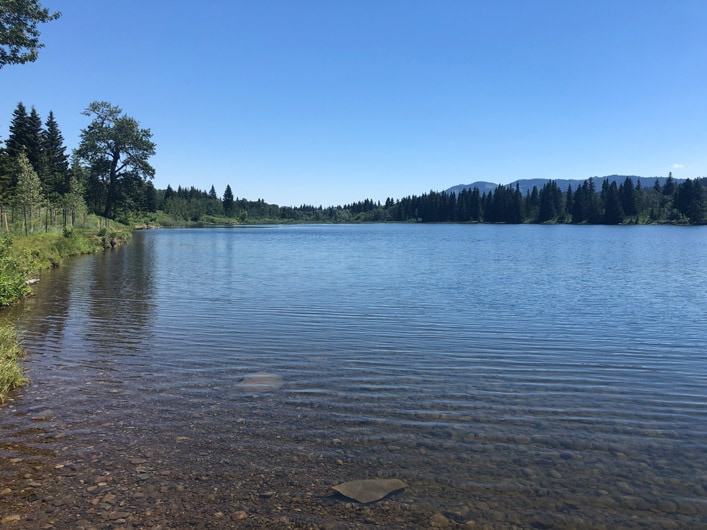
A waterbody might look perfectly good in May.
The water is cold.
The trout are active.
Then summer arrives.
Water temperatures rise.
Plant growth increases.
Water quality changes.
The same pond that looked excellent in spring can become stressful for trout later in the year.
Then winter creates another challenge.
This is why a pond being stocked does not necessarily mean it provides excellent trout habitat throughout all twelve months.
Some Alberta Trout Ponds Are Expected to Winterkill
This surprises people.
Why would Alberta stock trout into a pond if the fish might die during winter?
Because the purpose of every stocked pond is not necessarily to create a permanent self sustaining trout population.
Some are managed primarily to create accessible fishing opportunities.
Alberta Conservation Association stocks ponds near communities where natural fishing opportunities may be limited.
Many of those ponds are known to be vulnerable to winterkill and require annual stocking to maintain the fishery. (Alberta Conservation Association)
The goal is simple.
Put catchable trout into accessible water.
Give people somewhere to fish.
Allow legal harvest where the regulations permit it.
Then stock again when necessary.
This Is What Put and Take Fishing Means
You will often hear stocked trout ponds described as put and take fisheries.
Fish are put into the water.
Anglers catch them.
Where harvest is permitted, some are taken home.
The system is intentionally different from managing a vulnerable native trout population in a mountain stream.
In many stocked ponds, harvest is part of the management strategy.
That is why you should not automatically feel guilty for legally keeping a stocked rainbow trout from a pond designed to provide harvest opportunities.
Check the regulations.
If harvest is allowed and you want the fish for supper, that opportunity may be part of the reason the pond was stocked.
But Not Every Stocked Pond Is Supposed to Reset Every Year
This is where things become interesting.
Some stocked waters can support trout for several years.
Those fish continue growing.
Instead of every trout being roughly the size stocked during the current season, you may have several age groups.
This can create dramatically better fishing.
A recently stocked rainbow might be around the typical catchable size.
Another fish might have survived one winter.
Another might have survived several.
Suddenly the pond has genuine trophy potential.
That is one reason anglers pay attention to which Alberta stocked waters successfully overwinter fish.
Aeration Can Change Everything
Alberta Conservation Association operates an extensive lake aeration program specifically to improve survival in stocked fisheries.
Aeration adds or preserves oxygen in waterbodies that would otherwise be vulnerable to low dissolved oxygen.
ACA says the purpose is to promote year round trout survival and create better quality fishing opportunities. (Alberta Conservation Association)
This allows stocked fish to survive long enough to become larger than the trout originally released.
It turns some fisheries from places where you mostly expect recent stockers into waters where older fish may also exist.
How Does Aeration Work?
There are several ways to aerate water.
Some systems circulate water.
Others create open water where atmospheric oxygen can enter.
Subsurface systems can move water throughout the water column.
The technical approach can vary depending on the lake.
The important part for an angler is the result.
More dissolved oxygen.
ACA has historically targeted dissolved oxygen concentrations above approximately 3 milligrams per litre in its aeration work to support year round trout survival. (Alberta Conservation Association)
When the system works properly, trout have a much better chance of making it through difficult periods.
Aeration Is Not Only About Winter
Winterkill gets most of the attention.
Summer can be just as important.
Trout are cold water fish.
A shallow pond can become very warm during July and August.
Warm water naturally holds less oxygen than cold water.
At the same time, decomposition and biological activity can consume oxygen.
That can create an unpleasant combination for trout.
Warm water above.
Low oxygen deeper down.
The fish may have nowhere comfortable to go.
ACA says some stocked ponds may be unable to support trout even through the entire summer because of high temperatures and low dissolved oxygen. (Alberta Conservation Association)
So when someone says a stocked pond must have winterkilled, that is not always what happened.
The fish might have struggled months earlier.
A Current Alberta Example Shows How Difficult Pond Survival Can Be
ACA’s 2025 to 2026 Fish Stocking Evaluation provides a useful example.
At Beaumont Pond, monitoring found periods during summer when dissolved oxygen and temperature created poor conditions for fish.
Fall netting did not capture any fish there.
ACA notes that high water temperature, low dissolved oxygen and bird predation can all limit how long stocked trout survive in some ponds. (Alberta Conservation Association)
That is important because anglers often blame only one thing.
They assume fishermen caught every trout.
Or cormorants ate every trout.
Or winterkill removed everything.
Real pond ecology is usually more complicated.
Several pressures can operate at the same time.
Anglers Can Remove a Lot of Fish Too
Some stocked ponds receive tremendous fishing pressure.
ACA has documented summer angling pressure exceeding 2,000 angler hours per hectare at some stocked ponds. (Alberta Conservation Association)
That is a lot of fishing effort concentrated into relatively small water.
Think about what happens immediately after stocking.
Someone sees the stocking report.
They tell a friend.
The parking area fills.
People fish morning and evening.
Some release fish.
Some legally keep fish.
Other anglers arrive the next day.
The trout population can change quickly.
So if you visit a small pond six weeks after stocking and struggle to catch anything, winterkill obviously cannot explain what happened during those six weeks.
Fishing pressure may be part of the answer.
Birds Can Have an Impact
Anglers sometimes joke about competing with pelicans or cormorants.
There is some truth behind the frustration.
Stocked trout can provide an easy food source for fish eating birds, especially in small ponds where fish have limited places to escape.
ACA specifically includes avian predation among the factors it studies when evaluating stocked trout survival. (Alberta Conservation Association)
That does not mean every slow pond was emptied by birds.
It means predators are another piece of the puzzle.
Humans are fishing.
Birds are feeding.
Water conditions are changing.
Temperatures are rising.
Some trout survive all of it.
Others do not.
Why One Pond Produces Big Trout and Another Does Not
Suppose two Alberta ponds each receive 2,000 rainbow trout in May.
By August they could look completely different.
Pond A has cool water, reasonable depth and enough dissolved oxygen.
Fishing pressure is moderate.
Some trout survive.
Winter oxygen remains adequate.
A good portion of those fish make it into the following spring.
Pond B is shallow.
It becomes very warm during summer.
Fishing pressure is heavy.
Oxygen drops.
The remaining trout face another oxygen shortage beneath winter ice.
By next spring, very few may remain.
Same stocking.
Very different fishery.
This is why stocking numbers alone never tell the entire story.
An Aerated Lake Can Produce Older Trout
This is where the serious stocked trout angler starts paying attention.
ACA says aeration can allow stocked trout to survive for multiple years and reach substantially larger sizes. (Alberta Conservation Association)
Now imagine fishing that lake just after another spring stocking.
Most anglers see recently stocked trout near obvious access areas.
Those fish receive most of the attention.
But somewhere else in the lake could be older trout that have survived previous seasons.
Those fish may behave differently.
They may use different depths.
They may have learned to feed heavily on natural food.
They may not respond to the same simple presentation as newly stocked trout.
That is when a stocked lake becomes much more interesting.
The Biggest Trout May Not Be Near the Stocking Location
Freshly stocked trout can sometimes remain relatively close to release areas initially.
Older fish have already had months or years to explore the lake.
They know the habitat.
They know where food is concentrated.
They know where cooler water exists.
If you are specifically looking for older trout, do not spend the entire day fishing exactly where the stocking truck had easiest access.
Explore.
Fish structure.
Look for depth.
Look for feeding lanes.
Watch insect activity.
Pay attention to wind.
Think about where a trout that has lived in the lake for two years would want to be.
Spring Stocking Does Not Prove the Pond Was Empty
Another common assumption is:
They stocked it this spring, so everything from last year must have died.
Not necessarily.
Many waters are stocked annually even when some trout survive from previous years.
Stocking can maintain fish numbers while allowing older trout to remain.
ACA also stocks some ponds in fall when those waters are considered capable of supporting trout through winter. (Alberta Conservation Association)
So seeing a new stocking entry does not tell you that the population was completely reset.
It only tells you fish were added.
How Can You Tell if Trout Survived the Winter?
There is no perfect answer without fisheries sampling.
But anglers can look for clues.
The first clue is obvious.
Catch a fish much larger than the current year’s stocking size.
If small catchable trout were released recently and you catch a thick trout considerably larger than that, it likely came from an earlier stocking or another source.
You can also look at historical stocking records.
Was the lake stocked last year?
Two years ago?
Three years ago?
Does the waterbody have an aeration system?
Have anglers reported older fish?
Those clues start building a picture.
Use Alberta’s Stocking Maps
Alberta anglers have access to much better stocking information than many realize.
ACA currently provides a searchable stocked lake map covering more than 240 lakes and ponds stocked by ACA and the Government of Alberta. (Alberta Conservation Association)
The provincial Fish and Wildlife Internet Mapping Tool also includes fish culture stocking records with information such as species, stocking counts, dates and average fish size. (Geospatial Alberta)
Do not just look at whether a lake was stocked this year.
Look backwards.
The history can be more useful.
Look for Multiple Years of Stocking
Suppose you see this pattern.
2026: rainbow trout stocked.
2025: rainbow trout stocked.
2024: rainbow trout stocked.
2023: rainbow trout stocked.
That tells you the fishery is receiving regular support.
It does not tell you how many fish survived each year.
But now combine it with another clue.
The lake is aerated.
Now the possibility of older trout becomes considerably more interesting.
Compare that with a tiny shallow pond known to winterkill frequently.
The exact same four years of stocking data would mean something different there.
Why Are Some Trout Stocked in Fall?
Fall stocking can be especially interesting.
ACA says every pond in its stocking program receives spring stocking, while selected ponds considered likely to overwinter trout may also receive fall stocked fish to extend fishing opportunity. (Alberta Conservation Association)
Think about what that tells you.
If managers are intentionally putting trout into a pond shortly before winter, they believe there is at least a reasonable chance that the fishery can support them.
That does not guarantee every trout survives.
But it is useful information.
Can Trout Reproduce in Stocked Ponds?
Sometimes anglers catch a fish much larger or smaller than expected and immediately assume natural reproduction.
That is not always likely.
Many stocked ponds lack the flowing gravel habitat trout need for successful spawning.
ACA’s stocked pond program also commonly uses sterile catchable trout to reduce ecological risks and focus the fishery on angling opportunity. (Alberta Conservation Association)
So an unusually large fish in a stocked pond is often more likely to be an older stocked trout than a wild fish born there.
The exact answer depends on the species and waterbody.
Tiger Trout Add Another Interesting Possibility
Tiger trout are a sterile hybrid between brown trout and brook trout.
Alberta stocks them in selected waters.
Because they cannot establish a reproducing population, every tiger trout in one of these fisheries ultimately traces back to stocking.
If you catch a large tiger trout well after the most recent stocking, you may be looking at a fish that successfully survived one or more difficult seasons.
That is part of what makes fisheries capable of overwintering tiger trout particularly interesting.
Bear Pond Is a Good Example of the Question Anglers Ask
Bear Pond southwest of Calgary regularly generates this exact discussion.
Anglers know tiger trout have been stocked there.
Then winter comes.
The next summer someone asks whether those fish survived or whether the hike is worth making.
In July 2026, one Alberta angler specifically asked whether Bear Pond’s tiger trout were still worth the trip or whether the pond continued to winterkill. (Reddit)
There is no reliable way to answer a question like that purely from last year’s stocking entry.
You need current stocking information, recent angler observations and ideally fisheries information about survival.
That is why blindly reading a stocking list can be misleading.
A Pond Can Partially Winterkill
Winterkill does not always mean every fish dies.
Conditions vary across a waterbody.
Some pockets may retain better oxygen.
Different species and individual fish have different tolerances.
A severe oxygen decline might kill most trout while a small number survive.
The following spring, anglers may reasonably believe the lake completely winterkilled because catches are extremely low.
Then somebody hooks one large survivor.
Nature does not always give us a clean reset.
Fish Size Can Tell You Something
Pay attention to what you catch.
If every trout is roughly the same size, you may be fishing mostly the current stocking.
If you start catching several clearly different size classes, the lake becomes more interesting.
Small trout.
Medium trout.
A few much larger fish.
That suggests more than one age group may be present.
It does not prove overwintering on its own, but combined with stocking history it can provide a strong clue.
Condition Matters Too
Older trout often look different from newly stocked fish.
A recently released hatchery trout can sometimes look relatively lean or show fin wear associated with hatchery life.
After spending months feeding naturally, survivors can become much heavier and stronger.
Their appearance may improve.
Their behaviour can change too.
A trout that has spent a year feeding on aquatic insects and small fish may fight and feed differently from a fish that recently came from a hatchery.
Do Not Assume Bigger Means Easier
Older trout may actually be harder to catch.
They have survived anglers.
They have encountered lures.
They have learned where natural food is available.
They may spend more time away from heavily fished access areas.
This is one reason an aerated stocked lake can contain excellent trout and still feel difficult.
The fish exist.
They simply are not behaving like newly released stockers.
Summerkill Can Ruin Your Assumptions
Imagine you know a pond successfully overwintered trout.
You plan an August trip expecting bigger fish.
But the summer has been unusually hot.
Water temperatures remain high.
Algae becomes heavy.
Dissolved oxygen declines.
Suddenly the problem is not last winter.
It is this summer.
ACA is currently testing additional approaches to improve pond water quality because poor summer oxygen and warm water can significantly affect stocked trout survival. (Alberta Conservation Association)
This is why fisheries management does not end when the ice melts.
A Green Pond Can Be a Warning Sign
Not every green lake is experiencing dangerous conditions.
But heavy algae growth in a small shallow pond should make you pay attention.
Algae and other biological activity can contribute to large oxygen changes.
When algae die and decompose, oxygen can be consumed.
Warm weather makes conditions harder for cold water trout.
If you arrive during a prolonged heat wave and the pond looks extremely productive and warm, trout may be stressed even if plenty were stocked earlier.
Do Not Target Stressed Trout Just Because You Know They Are There
Sometimes the better fishing decision is not fishing.
If water is extremely warm and trout are obviously struggling, repeated catch and release adds more stress.
Fish early.
Choose cooler water.
Try another lake.
The fact that trout were stocked for anglers does not mean we need to catch them under every possible condition.
A little restraint can preserve better fishing for later.
Aerators Create a Serious Ice Safety Issue
There is one part of aerated lakes that anglers cannot ignore.
Aeration changes ice.
ACA warns that aerators can create open water and unpredictable thin ice around the system. (Alberta Conservation Association)
Do not assume that because you safely crossed a particular section last winter, it is safe this winter.
Do not assume thick ice twenty metres away means thick ice near an aerator.
Conditions can change dramatically over short distances.
Warning signs exist for a reason.
Never Use the Aerator as Your Ice Fishing Landmark
It can be tempting.
You know oxygen is being added.
You assume trout might gather nearby.
So you start thinking about fishing close to the aeration area.
That is not worth the risk.
Open water and dangerously thin ice can extend farther than you expect.
Stay well away from aeration hazards and obey posted warnings.
There are plenty of places to catch trout.
You do not need to turn the aerator into a fishing spot.
Why Aerated Lakes Can Be Excellent Ice Fisheries
The irony is that the same aeration system creating an ice hazard can also improve the fishery.
Better oxygen allows trout to remain active and survive through winter.
Instead of gradually becoming stressed as oxygen declines, fish may have much more suitable conditions.
That can provide legitimate ice fishing opportunities in appropriate safe areas of the lake.
The key words are appropriate and safe.
Aeration improves fish habitat.
It does not make every piece of ice safe.
How I Would Choose a Stocked Trout Lake if I Wanted Bigger Fish
I would not simply choose whichever lake received the largest number of trout this spring.
I would look for a different set of clues.
First, I would check several years of stocking history.
Then I would see whether the lake is aerated.
I would look for evidence of fall stocking.
I would look at the size and depth of the waterbody.
I would search for recent reports mentioning larger trout.
I would check whether the regulations are designed to allow fish to survive into larger size classes.
Then I would decide whether the lake appears capable of supporting trout for more than one season.
That is much more useful than simply asking:
Which lake got the most fish?
If I Wanted Easy Action Instead
My strategy would be completely different.
I would look for recent stocking.
I would choose an accessible pond.
I would fish relatively soon after trout were released.
I would not care nearly as much about whether fish survived from three years ago.
That is the beauty of Alberta’s stocked trout system.
Different waters can serve different purposes.
Some are good places to take a child for a first trout.
Others are worth learning because surviving fish can become much larger.
Recent Stocking and Good Overwintering Are Two Different Advantages
Do not confuse them.
A recently stocked pond can provide excellent action because there are many new fish.
A good overwintering pond can provide excellent fishing because older fish survive.
The very best stocked fisheries can offer both.
Fresh trout provide numbers.
Older survivors provide surprises.
That is when every strike becomes interesting because you do not know whether the fish is eight months old or several years old.
Do Not Write Off a Pond Because It Was Slow
Stocked trout fishing produces plenty of false conclusions.
Someone fishes for one hour.
No bites.
They post:
The pond winterkilled.
Maybe.
Or the trout are deeper.
Or they are feeding on insects.
Or most recent stockers have spread away from the access point.
Or fishing pressure removed many fish.
Or the water is too warm and the fish are inactive.
Or the pond genuinely did experience poor survival.
One slow evening does not answer the biological question.
And Do Not Assume Jumping Trout Mean the Pond Is Healthy
The opposite mistake happens too.
You see trout rising everywhere.
Therefore the pond must contain thousands of healthy fish.
Surface activity tells you fish are present.
That is useful.
It does not tell you how many fish exist or what their long term survival will be.
A pond can produce spectacular evening rises in June and still suffer poor conditions later in summer.
Pay attention to the entire season.
The Best Clue Is History
If you really want to understand a stocked trout pond, follow it for several years.
Look at stocking dates.
Fish it during spring.
Fish it during summer.
Try it in fall.
See what people catch through winter where safe and legal.
Notice whether larger fish appear the following year.
Eventually you begin to understand what kind of fishery it is.
Some Alberta stocked ponds are temporary trout factories.
Others quietly produce fish far larger than most people expect.
That difference comes down to much more than how many trout arrived on the stocking truck.
Before Your Next Stocked Trout Trip
Check the current ACA stocked lake map.
Look at the provincial stocking records.
Then ask a better question than:
Was this pond stocked?
Ask:
Can this pond actually keep trout alive?
Look for aeration.
Look for previous years of stocking.
Look for fall stocking.
Consider pond depth and summer conditions.
Check recent reports.
Then decide what kind of fishing you expect.
If you are chasing recently stocked trout, fresh stocking information matters most.
If you are hoping for the trout nobody has caught for two years, survival matters much more.
That is when Alberta’s stocking data stops being just a list of fish dumped into lakes.
It starts telling you what kind of fishery might be waiting there.

Recent Fishing Reports