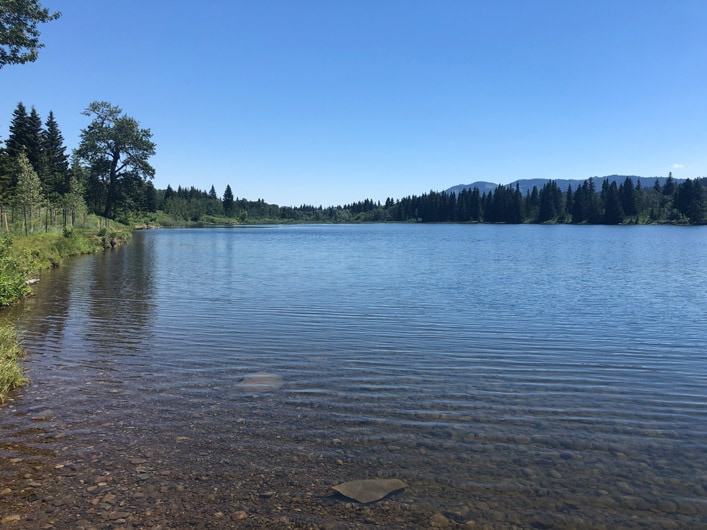
Upper Kananaskis Lake looks like it should be easy to fish.
Clear mountain water.
Rocky shoreline.
Trout.
Plenty of places to stand and cast.
Then you actually fish it.
An hour goes by.
Nothing.
You move.
Nothing.
You start wondering whether there are any fish within casting distance at all.
That experience is fairly normal.
Upper Kananaskis Lake can be a difficult place to fish from shore, especially if you approach it like a small stocked trout pond.
The lake is large, deep and extremely clear. Fish have plenty of water available to them, and they do not need to spend their day cruising five metres from shore waiting for your spinner.
That does not mean shore fishing is pointless.
It means location, timing and depth become much more important.
Do Not Treat Upper Kananaskis Like a Stocked Pond
This is the first adjustment.
At a small stocked pond, you can often choose almost any accessible shoreline and eventually have trout swim within casting distance.
Upper Kananaskis is completely different.
There is far more water.
Fish can move vertically as well as horizontally.
They can hold well beyond normal casting distance.
They can also concentrate around particular pieces of structure while huge stretches of apparently beautiful shoreline contain very little activity.
Standing in one random location and casting for four hours is not a great plan.
You need to search.
Your First Goal Is Finding Deep Water Close to Shore
For a shore angler, this is one of the most important features on the lake.
You want access to different depths without needing a boat.
A shoreline where shallow water continues far into the lake can be frustrating because fish holding deeper may remain completely beyond your reach.
Instead, look for sections where the bottom appears to fall away relatively quickly.
Steeper surrounding terrain can sometimes provide a clue.
Rocky points are also worth investigating.
You are looking for places where a single cast can pass through several depths.
That gives you a much better chance of finding fish.
Rocky Points Are Excellent Places to Start
Points give shore anglers several advantages.
You can cast in different directions.
You may reach deeper water from the end of the point.
Current created by wind can move around the structure.
Fish travelling along the shoreline may also pass around it.
Do not stand on the tip and make every cast directly toward the middle of the lake.
Fish one side.
Then the end.
Then the other side.
Change your casting angle.
Allow your lure to reach different depths.
One small part of the point may produce while everything around it appears empty.
Depth Is Probably More Important Than Colour
This is not the place where I would spend half the afternoon changing from a silver spoon to a gold spoon and then to a green spinner.
First figure out where your lure is travelling.
Suppose you cast a spoon and begin retrieving immediately.
You are fishing relatively high in the water.
Nothing happens.
Make another cast and give the spoon a few seconds to sink.
Then retrieve.
Next cast, let it sink a little longer.
You are now searching different depths without changing anything else.
If you eventually get a strike after allowing the lure to sink for several seconds, remember that.
Repeat it.
The fish just gave you useful information.
Count Your Lure Down
This is a simple technique that works well with sinking lures.
Cast.
Count.
Then retrieve.
Maybe you begin with three seconds.
Next cast, five.
Then seven.
You do not need the lure to reach the bottom every time.
You are trying to systematically search the water.
Once you find the depth producing follows or strikes, keep returning to it.
This is much better than making random casts and hoping your lure happens to pass a trout.
Small Spoons Are a Good Starting Point
A spoon makes sense for shore fishing because it casts well.
Casting distance can matter on a large lake.
Spoons can also be fished at several depths.
Retrieve immediately and you can fish relatively shallow.
Allow the lure to sink and you can explore deeper water.
You can retrieve steadily.
You can pause.
You can allow the spoon to flutter.
That gives you plenty of options without carrying a large tackle box.
The important part is learning what your spoon is doing.
Do not simply cast and reel at the same speed all day.
Spinners Can Work Too
Inline spinners are another practical option.
They create vibration and flash and are easy to fish.
The challenge is getting them deep enough when trout are not near the surface.
A very light spinner retrieved quickly may spend the entire cast above the fish.
Try allowing it to sink before beginning the retrieve.
Then retrieve only quickly enough to keep the blade working.
If you feel the lure repeatedly contacting rocks, you have probably gone too deep.
Adjust on the next cast.
Try Smaller Presentations in Clear Water
Clear mountain lakes can make fish cautious.
They have plenty of opportunity to inspect what you are offering.
That is one reason I would not automatically begin with the largest, brightest lure available.
Smaller spoons, spinners, flies and soft plastics can be worth trying.
Natural looking presentations deserve space in the tackle box.
The goal is not to create the largest possible disturbance.
The goal is to put something convincing in front of a trout.
Casting Distance Matters, but Do Not Become Obsessed With It
There are days when the fish simply seem to be beyond shore casting range.
That is part of fishing a large mountain lake.
But do not assume every fish is far away.
Fish can move closer to shore during favourable conditions.
Low light can help.
Wind can help.
Food can bring them closer.
The mistake is believing the longest cast automatically gives you the best chance.
A shorter cast along productive structure may be much better.
Fish Parallel to Shore
Almost everyone arrives at a lake and casts directly outward.
Try changing the angle.
If you are standing beside a steep rocky shoreline, trout may travel along that edge.
A cast parallel to shore keeps your lure in that zone much longer.
A cast directly toward open water may leave the productive area almost immediately.
This works particularly well around points and changes in shoreline structure.
Morning Can Give Shore Anglers an Advantage
If I were planning a summer shore fishing trip to Upper Kananaskis Lake, I would seriously consider arriving early.
Low light can encourage trout to use water they may avoid during bright conditions.
The shoreline is also quieter.
Wind is sometimes more manageable.
Instead of arriving after lunch because that is convenient, give yourself a chance to fish the morning feeding period.
This becomes especially useful when you are limited to shore.
You want the fish moving toward you rather than spending the entire day trying to reach them.
Evening Deserves Attention Too
The last few hours of daylight can create another opportunity.
Light falls.
Temperatures change.
Insect activity can increase.
Fish may begin moving.
A shoreline that seemed completely lifeless in the afternoon can suddenly become interesting.
If you are camping nearby, use that advantage.
Fish early.
Take a break during the middle of the day.
Return in the evening.
That is often a better use of your time than casting continuously through the least productive conditions.
Watch for Rising Fish
Mountain trout can reveal themselves.
You might see a small rise.
A swirl.
An occasional fish breaking the surface.
Do not immediately throw your largest spoon directly onto the ring.
Watch first.
If several fish are rising repeatedly, insects may be involved.
That changes the problem.
Your spinner may be passing fish that are concentrated on something much smaller.
A Casting Bubble Can Be Useful
You do not need a fly rod to present a small fly.
A casting bubble allows a spinning rod to cast a lightweight fly much farther than the fly could travel on its own.
That can be extremely useful on a large lake.
If trout are visibly feeding on insects beyond normal fly casting range, this gives a spinning angler another option.
It also lets you offer something much smaller than a spoon.
Wind Can Improve Your Chances
Perfectly calm mountain water looks beautiful.
It is not always the easiest fishing.
Moderate wind can break up the surface and reduce how easily fish can see you.
Wind can also move surface food toward particular sections of shoreline.
Look at where the wind has been blowing.
If one accessible shoreline has received a manageable wind for several hours, investigate it.
Do not automatically hide on the calm side because casting is easier.
The slightly rougher shoreline may be more interesting.
But Kananaskis Wind Deserves Respect
Mountain weather can change quickly.
A pleasant lake can become rough.
If conditions become unsafe, fishing quality does not matter.
This is especially important if you eventually decide to use a canoe, kayak or other small watercraft.
Shore anglers have an advantage here.
You can simply move or stop fishing.
Pay attention to changing conditions rather than becoming completely focused on catching one trout.
Move More
This is probably the biggest practical difference between successful and unsuccessful shore fishing here.
Do not establish yourself permanently in the first convenient location.
Travel light enough that moving is easy.
One rod.
A small tackle selection.
Pliers.
Your required outdoor and safety equipment.
Then explore.
Fish a point.
Nothing?
Walk.
Try the next change in shoreline.
Fish different depths.
Walk again.
A large lake rewards anglers who search.
Do Not Assume Easy Access Means Good Fishing
The easiest place to reach is naturally where many people fish.
That does not mean it is the most productive shoreline.
Look around.
Where can you legally reach a point?
Where does deeper water approach shore?
Where is wind affecting the lake?
Where does the shoreline become rocky?
Where are fish actually rising?
Choose water based on fishing potential rather than distance from your vehicle.
A Short Walk Can Change the Fishing
Many anglers are willing to walk from the parking area to the water.
Far fewer want to continue walking once they arrive.
That creates opportunity.
You do not necessarily need a secret location.
Sometimes you only need to explore beyond the first convenient shoreline.
The farther you move from obvious access, the fewer repeated casts fish are likely to see.
Do Not Chase Every Visible Fish
You see a trout rise thirty metres to your left.
You walk over.
Now another fish rises where you were standing.
You walk back.
This becomes frustrating quickly.
Instead, watch for patterns.
Are several rises occurring along one depth line?
Are fish travelling parallel to shore?
Is activity concentrated around a point?
Is wind pushing food into one area?
Fish the reason trout are there rather than chasing individual rings.
Shore Fishing Can Simply Be Difficult Here
There is no useful reason to pretend otherwise.
Some days, the fish may be deeper than you can effectively reach.
A boat, kayak or other suitable watercraft can open a completely different amount of water.
That does not make shore fishing impossible.
It simply means expectations matter.
You are fishing a large mountain lake with enormous amounts of available habitat.
A trout does not need to cooperate with your casting range.
That Is Why Timing Matters So Much
A boat angler can move toward deeper fish.
A shore angler has to wait for opportunities when fish become accessible.
Morning.
Evening.
Wind.
Cloud cover.
Insect activity.
Seasonal movements.
Those conditions can bring fish into water you can reach.
Your strategy should take advantage of them.
Do Not Judge Upper Kananaskis After One Trip
This is an easy lake to misunderstand.
You fish for three hours.
Nothing happens.
You conclude the fishing is terrible.
Then someone else catches trout from the same general area under completely different conditions.
Return at another time.
Try morning instead of afternoon.
Try evening.
Try wind instead of dead calm.
Try another shoreline.
Try deeper presentations.
One trip gives you one small sample of a large and complicated lake.
Pay Attention to Exactly Where a Fish Comes From
When you finally get a follow or strike, stop treating it as random.
Think.
How long did the lure sink?
How far from shore were you?
Were you beside a point?
Was there wind?
Were you retrieving steadily?
Did the fish strike during a pause?
Was your lure moving parallel to shore?
Then repeat what worked.
If you catch another fish under similar circumstances, you may have discovered a pattern.
That pattern is more valuable than knowing somebody else’s exact fishing spot.
Know the Regulations Before You Fish
Upper Kananaskis Lake is within an area containing important trout fisheries, including bull trout, and fishing regulations can include very specific rules for individual waters and portions of waters. Alberta publishes updated sportfishing regulations annually.
Check the current regulations before every trip.
Do not rely on a screenshot from an old season.
Do not assume the rules are identical to another Kananaskis lake.
Do not assume that because you legally kept a particular species somewhere else, you can keep it here.
If you are leaving cell service, save the relevant regulations before you go.
Check Current Kananaskis Advisories Too
Kananaskis conditions can change for reasons unrelated to fishing.
Trails, recreational areas and access routes can be affected by wildlife activity, construction and temporary closures. Alberta Parks maintains current advisories for Kananaskis Country.
Checking before you leave Calgary takes a minute.
Discovering a closure after driving into Kananaskis takes considerably longer.
What I Would Bring for a First Shore Fishing Trip
I would keep the tackle simple.
A spinning rod capable of casting small trout lures.
Several small spoons.
Several inline spinners.
A few small soft plastic presentations.
A casting bubble and a few flies if surface feeding is possible.
Pliers.
Polarized sunglasses.
Then I would spend far more effort choosing where and when to fish than deciding which twenty lure colours to bring.
What I Would Actually Do When I Arrive
I would spend the first few minutes looking at the lake.
Where is the wind going?
Can I see surface activity?
Which accessible shoreline appears to reach deeper water?
Where are the points?
Then I would choose one promising area.
First cast relatively shallow.
Next cast slightly deeper.
Then deeper again.
I would vary the casting angle.
I would fish parallel to shore.
If nothing happened after thoroughly covering the available water, I would move.
When I finally found a fish, I would stop experimenting randomly and try to reproduce exactly what produced the encounter.
Upper Kananaskis is not the kind of lake where standing in one convenient place and endlessly changing lure colours is likely to teach you much.
The better approach is finding the small sections of shoreline where depth, structure, weather and trout movement finally overlap within casting distance.
That is where shore fishing starts becoming much more interesting.